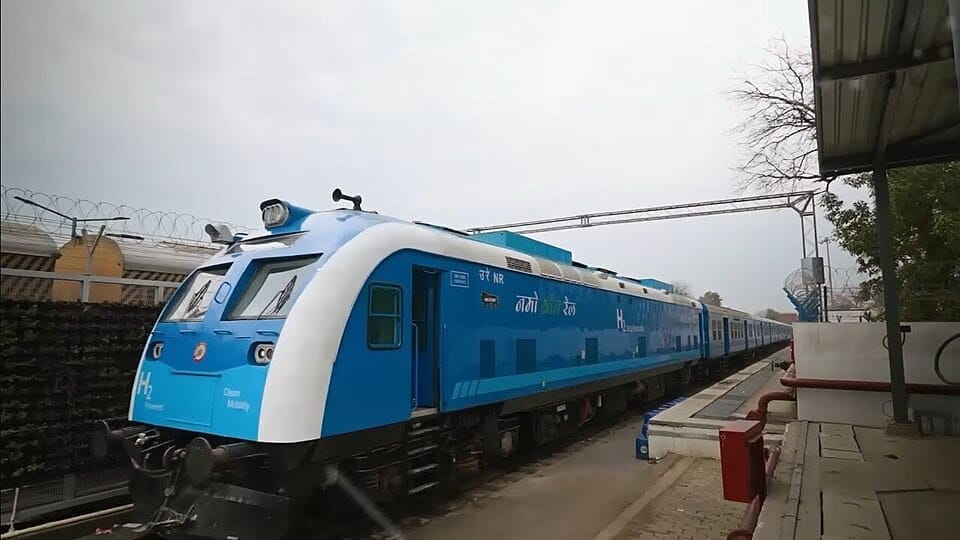
On the morning of 17 July 2026, a ten-coach train pulled out of Jind railway station in Haryana with water vapour as its only exhaust. Prime Minister Narendra Modi flagged it off and called the day a landmark for a self-reliant, sustainable India. The train, named NaMo Green Rail, is the country’s first hydrogen-powered passenger service. With it, India joins a small club of nations, alongside Germany, China, Japan and the United States, that have put this technology on working tracks.
The train itself is only part of the story. What India has switched on at Jind is a full hydrogen railway ecosystem, built at home and a live test of whether the fuel can earn a real place in the world’s fourth-largest rail network.
What Is Actually Running
The NaMo Green Rail runs on the 89-kilometre Jind-Sonipat section of Northern Railway, making two return trips a day through Gohana Junction and intermediate stations. It is a ten-coach formation, two hydrogen-powered driving cars with eight passenger coaches between them. It can carry around 2,600 passengers. Indian Railways says that makes it the world’s longest hydrogen-fuelled passenger service. It runs at up to 75 kilometres per hour in service, with a design speed of 110.
Under the floor sits a 1,200-kilowatt fuel cell propulsion system. A fuel cell works like a battery that never runs down as long as it is fed. Hydrogen and oxygen combine inside it through a chemical reaction that produces electricity. The only direct by-product is water vapour. No diesel burns anywhere on the train.
The hardware is Indian from the drawing board up. The Integral Coach Factory in Chennai built the train, working to designs and standards from the Research Designs and Standards Organisation. Jind now hosts the country’s first integrated hydrogen production, storage and refuelling facility for rail, with a dedicated power supply to keep the plant running. The train carries multi-layer safety systems that watch for hydrogen leaks, heat, flame and smoke, a sensible precaution for a fuel that demands respect.
Why Hydrogen, When India Has Electrified Almost Everything
A fair question hangs over the project. India has electrified nearly all of its 70,000-kilometre network, one of the largest electrification drives in railway history. Why bother with a new fuel at all?
The answer lies in the gaps. Some routes will never justify the cost of overhead wires: remote branch lines, hilly terrain, heritage sections and low-traffic corridors. Today those routes run on diesel, which is exactly the dependence Indian Railways wants to end. Hydrogen slots into that niche. It offers zero-emission running without a single mast or cable, because the train carries its power plant with it.
The timing follows a wider push. India has set a national target of net-zero emissions by 2070. Indian Railways has set itself the far tighter goal of net-zero by 2030. The government is also spending heavily on green hydrogen as an industry of its own. A hydrogen train is where those two ambitions meet on steel wheels.
There is a manufacturing thread running through this too. The project was developed under Make in India, from design through prototype, rather than bought from a foreign supplier. That mirrors the pattern across India’s harder technology bets, from semiconductors to private space launch: build the difficult thing at home, even when importing it would be faster, because the know-how is the point.
The Honest Caveats
A clear-eyed reading demands the other side of the ledger.
Hydrogen is clean only at the point of use. If the gas comes from fossil fuels, as most industrial hydrogen worldwide still does, the emissions simply move from the train’s exhaust to the production plant. The environmental case stands or falls on whether Jind’s fuel eventually comes from electrolysis powered by renewables, the “green hydrogen” India’s national mission is chasing. That transition is planned, not finished.
Cost is the second caveat. Fuel cells, hydrogen storage and refuelling infrastructure remain expensive. A single 89-kilometre pilot cannot prove the economics for a national rollout. Germany, which ran the world’s first hydrogen train fleet from 2022, has since found battery-electric trains cheaper on some routes and scaled its ambitions accordingly. India will face the same arithmetic. Batteries improve every year and on shorter non-electrified routes they may undercut hydrogen before hydrogen matures.
None of this makes the project a mistake. Pilots exist precisely to surface these answers. But the NaMo Green Rail is the start of an experiment, not the end of one and honest coverage should say so.
What Comes Next
Indian Railways has spoken of extending hydrogen operations to heritage and hill routes, the corridors where the technology’s case is strongest and electrification is hardest. The Jind facility gives the country a template. It is a production, storage and refuelling ecosystem that can be replicated where it makes sense. Each new route will test the fuel’s reliability, its cost per kilometre and the supply chain behind it.
The more interesting horizon sits beyond the railway. A country that learns to produce, store, move and safely handle hydrogen at scale for trains builds skills that transfer elsewhere. Shipping, heavy trucking, steelmaking and fertiliser are the sectors where hydrogen may matter most. In that sense, the Jind-Sonipat line doubles as a national classroom.
A Train and a Signal
Strip away the ceremony and what remains is measured but real. One route, one train, two round trips a day. That is a modest service by the standards of a network that moves more than 20 million people daily. Yet the signal travels further than the train does. India has designed, built and commissioned a working hydrogen rail ecosystem on its own. It has joined a technology club with only a handful of members and opened a live laboratory for a fuel that may power far more than railways. The NaMo Green Rail will not transform Indian transport by itself. It marks the moment India decided to find out whether hydrogen can.