On a February morning in 2026, in a town called Sanand in Gujarat, something happened that had never happened in India before. A factory began packaging finished semiconductor chips on Indian soil at commercial scale, the first plant of its kind in the country to switch on. For a nation that designs a large share of the world’s chips yet had never built them at home, it was a quiet turning point.
It also raised the question that hangs over the entire effort. Packaging a chip is not the same as making one. India has spent decades as the world’s back office for chip design, its engineers drawing the blueprints for processors that were then built somewhere else. The country is now spending lakhs of crores to change that. The real test is whether it can move from assembling and packaging chips to actually fabricating them, the hardest and most guarded step in the whole business.
This is the story of the India Semiconductor Mission: what it has built, where it falls short and whether India’s bet on chips can pay off.
Why India Missed the Bus
India’s absence from chipmaking was not for lack of trying. The country set up its own Semiconductor Laboratory in Mohali back in the 1980s, around the same time as several Asian rivals. Yet while Taiwan, South Korea and later China poured decades of money and political will into building fabrication plants, India’s attempts stalled, lost to funding gaps, shifting priorities and a fire that crippled the Mohali facility in 1989.
What India did build, almost by accident, was design talent. Global chip giants set up enormous engineering centres in Bengaluru, Hyderabad and beyond and Indian engineers came to work on a huge portion of the world’s chip designs. The catch was ownership. They designed chips for foreign companies, who kept the intellectual property, the profits and the manufacturing. India had the brains of the industry but none of the factories and none of the patents that matter most.
The failures kept coming even as the ambition grew. In 2013 and 2014 the government cleared two grand fab proposals from foreign-led consortia, but both collapsed before a single brick was laid, undone by cold feet and the sheer cost of the gamble. As recently as 2023, a high-profile tie-up between Vedanta and Foxconn fell apart, a reminder of how easily these projects unravel. Each false start hardened a belief in New Delhi that chipmaking was a race India had simply missed.
ISM 1.0: What It Actually Built
The push to fix this began in December 2021, when the government launched the India Semiconductor Mission with a corpus of 76,000 crore rupees. Its pitch to investors was blunt: the state would cover up to half the cost of building a plant, with extra help from state governments on land, water and power.
Soon, the money moved. By the end of 2025 the government had cleared ten projects worth around 1.60 lakh crore rupees across six states and in May 2026 it approved two more units, taking the tally past a dozen. For a country that made nothing a few years earlier, that is certainly a fast start.
What made this attempt stick where earlier ones failed was the depth of the subsidy and the patience behind it. After all, covering half the cost of a multi-billion-dollar plant is an enormous commitment. Moreover, pairing it with state-level help on land and utilities also removed the everyday frictions that had scared investors off before. As a result, the promise was credible enough that global names finally signed on the dotted line rather than walking away.
There is a catch and an honest account has to name it. Indeed most of what the first phase attracted sits at the back end of the chain: assembly, testing and packaging, known in the trade as ATMP and OSAT. These are real factories with real jobs and they count. However, they are not the same as fabrication, where raw silicon wafers are turned into working chips. Proposals for leading-edge logic fabrication, the crown of the industry, mostly did not translate into shovels in the ground. Instead, the one true fab now rising, at Dholera, will make mature-node chips rather than the bleeding-edge processors that drive phones and AI.
The Projects on the Ground
Strip away the announcements and a real map of factories emerges, clustered mostly in Gujarat with outposts in Assam, Uttar Pradesh and Odisha.
The flagship is the Tata Electronics fab at Dholera, built with Taiwan’s Powerchip (PSMC). This is India’s first true wafer-fabrication plant, with first silicon targeted for late 2026 and full operation expected around 2028. It will produce mature-node chips for cars, appliances and power electronics, a sensible place to begin.
Dholera itself is a statement. The fab is rising inside a planned greenfield industrial city built largely from scratch, with dedicated power, water and road links laid in specifically to court chipmakers. Notably choosing an empty canvas rather than retrofitting an old industrial belt signals how seriously the project is being taken, yet it also means India is building the town and the factory at the same time.
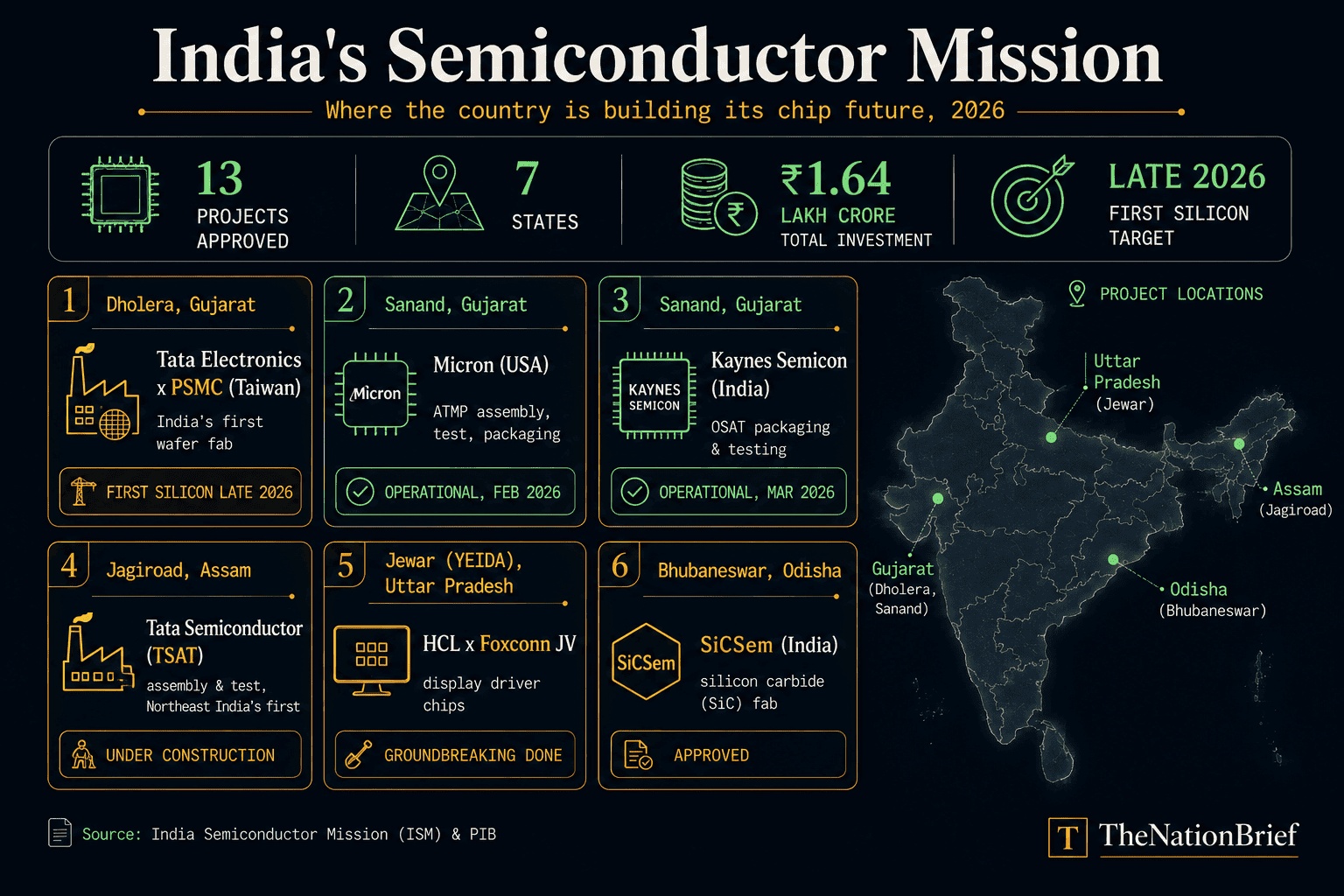
At Sanand, three projects sit close together. Micron’s plant, the one that switched on in February 2026, packages and tests memory chips. Weeks later, in March, Kaynes Semicon opened its own packaging unit at the same hub. A third, a joint venture of CG Power, Japan’s Renesas and Thailand’s STARS Microelectronics, is building there too.
Beyond the Flagship Fab
In Assam, Tata is putting up a large assembly and test facility at Jagiroad, the first time the industry has reached India’s Northeast. Uttar Pradesh hosts an HCL and Foxconn joint venture, which broke ground near the Jewar airport in February 2026 to make display driver chips. In Odisha, a company called SiCSem began work in April 2026 on a plant for silicon carbide, a tougher material used in electric vehicles and power systems, paired with the country’s first 3D packaging line.
Here is the picture at a glance:
| Project | Location | Type | Partner | Stage in 2026 |
|---|---|---|---|---|
| Tata fab | Dholera, Gujarat | Wafer fab, mature node | Powerchip, Taiwan | First silicon late 2026 |
| Micron | Sanand, Gujarat | Assembly, test, packaging | Micron, USA | Operational, Feb 2026 |
| Kaynes Semicon | Sanand, Gujarat | OSAT packaging | Indian | Operational, Mar 2026 |
| CG Power JV | Sanand, Gujarat | OSAT packaging | Renesas, STARS | Under construction |
| Tata TSAT | Jagiroad, Assam | Assembly and test | Indian | Under construction |
| HCL JV | Jewar, Uttar Pradesh | Display driver chips | Foxconn, Taiwan | Groundbreaking done |
| SiCSem | Bhubaneswar, Odisha | Silicon carbide, 3D packaging | Indian | Groundbreaking done |
Read the table and the pattern is clear. India is strong on the packaging and testing end, has one real fab on the way at the mature node and nothing yet at the bleeding edge.
ISM 2.0: The Big Pivot
By the time the 2026 budget came around, the government had learned a hard lesson from the first phase: a fab cannot run on its own. After all it needs a web of suppliers feeding it specialized machines, ultra-pure chemicals, gases and blank wafers, almost none of which India makes. Build only the factories and you have simply swapped one kind of import dependence for another.
So the second phase, India Semiconductor Mission 2.0, announced in the Union Budget for 2026-27 with an initial 1,000 crore rupees, changes the target. Where the first phase chased fabs and packaging plants, the new one instead aims at the layers beneath them: home-grown manufacturing equipment, chemicals and materials, full-stack Indian chip-design IP, stronger supply-chain firms and industry-led research and training centers. The slogan, in effect, is a move from fabs to ecosystems.
Electronics minister Ashwini Vaishnaw framed the shift around indigenous design, productisation, ecosystem partners and talent. Backing it up, the budget widened a separate electronics-components scheme to 40,000 crore rupees and set aside 8,000 crore rupees for the broader manufacturing programme in 2026-27. The ambition is no longer just to assemble chips in India, but to build the machinery and master the recipes that make chips possible.
The logic of the pivot is hard to argue with. A country can subsidise a dozen fabs and still find itself helpless if a single foreign supplier of photoresist or lithography parts decides to stop shipping. Owning even a slice of that supply chain turns India from a tenant in the industry into a part-owner. It is a slower, less glamorous bet than cutting a ribbon on a new plant, but it reaches for the kind of self-reliance that actually survives a crisis.
Update, July 2026: The Union Cabinet formally approved ISM 2.0 on 15 July, with a total outlay of Rs 1.25 lakh crore. A five year scheme offering a flat 30 percent incentive for equipment, chemicals and materials manufacturers. The government now projects total investment across the mission reaching Rs 4 lakh crore.
India’s Hidden Strength: Chip Design
If fabrication is India’s weakness, design is its quiet advantage. The Design Linked Incentive scheme now backs 24 home-grown chip-design startups, which have together drawn around 430 crore rupees in venture funding. New Delhi has pushed open-source processor work through a national RISC-V programme, a route that sidesteps costly foreign licenses and it has rolled out an indigenous microprocessor line named DHRUV64.
The supporting scaffolding has grown too. The old Semiconductor Laboratory at Mohali has been folded into the modernization drive, a Chips-to-Startup programme hands students and young firms access to costly design tools, while the national design platform has logged well over two crore hours of tool use. None of this builds a fab. All of it builds the layer of skilled engineers and small companies that a chip industry needs to stand on.
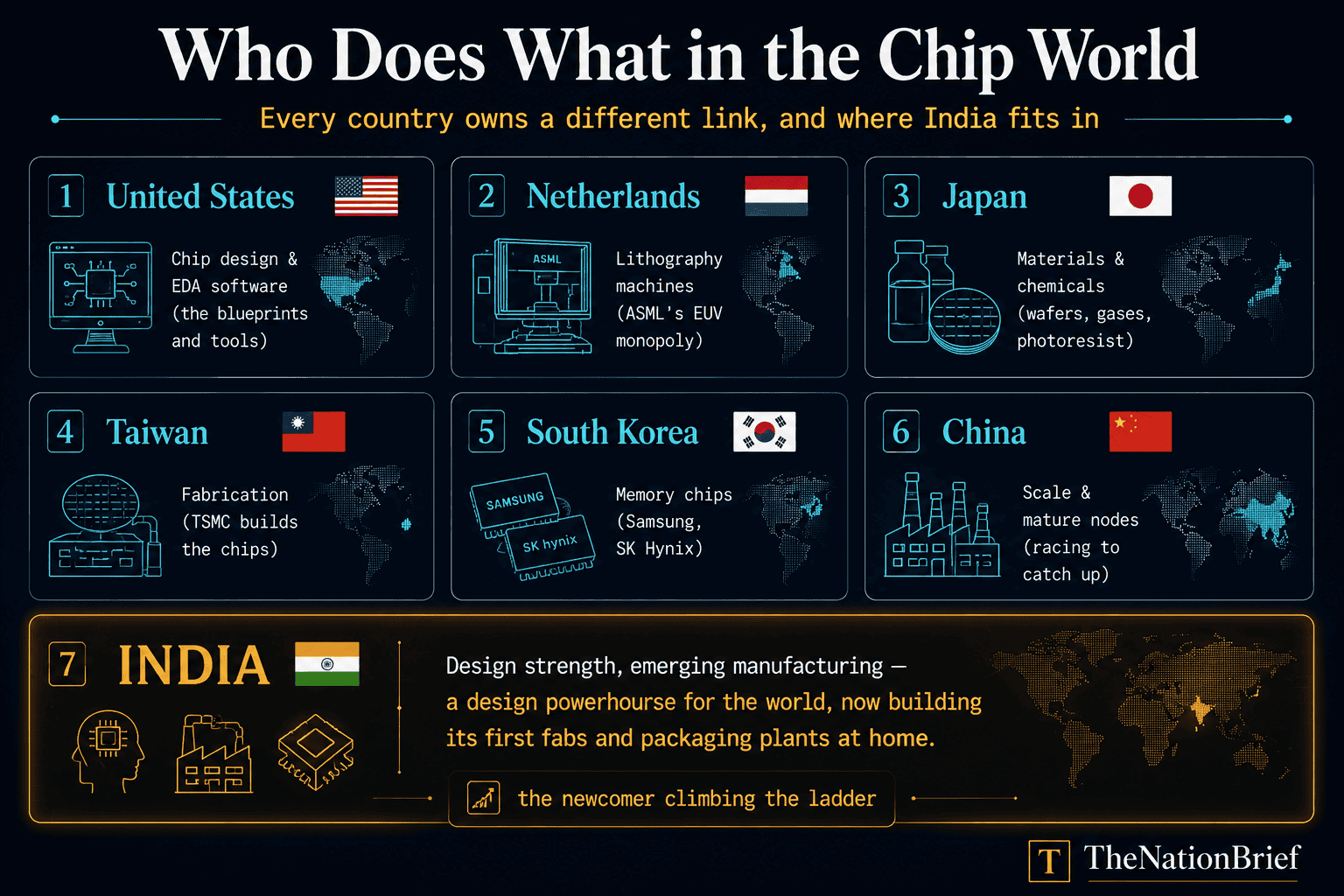
This is where India can move fastest, because it builds on talent the country already has in abundance. The aim of the second phase is to convert that talent from a service, designing chips for others, into ownership, designing and selling Indian chips with Indian IP. Closing that gap would be worth more in the long run than any single factory, because it is the part of the industry where the margins and the control truly sit.
The Hard Gaps
Honesty demands a clear look at how far India still has to go.
The deepest problem is the upstream supply chain. The machines that etch chips, the chemicals and gases that process them, the blank wafers they start from, nearly all of it is imported. A fab in Gujarat can run only as long as those shipments keep arriving, which means India has reduced its reliance on foreign chips while deepening its reliance on foreign chipmaking inputs.
The geopolitics cut deeper still. Many of the rarest inputs, from certain gases to specialist materials, are controlled by a small group of countries, with China dominating several of them outright. In a tense neighbourhood, that leaves India exposed to the same kind of pressure it is trying to escape, a vulnerability that no amount of domestic factory-building solves on its own.
Update, July 2026: Partnerships help close that gap. At the 16th India-Japan Annual Summit, the two countries agreed to a joint roadmap on semiconductor and mineral supply chains, the kind of external backing India’s chip ambitions still depend on.
Update, July 2026: India has also moved on the minerals side of this problem. A new Critical Minerals Corridor with Australia, agreed in Melbourne, aims to secure the lithium, gallium and rare earth inputs that India’s chip and battery ambitions still depend on.
Talent, for all its depth, carries its own gap. India’s engineers cluster in design services and rarely own the finished product, so the country has few chip brands of its own. Building fabrication and process know-how, the muscle that runs a plant at high yield, is a different skill that India is only starting to grow.
Then come the plain physical demands. A modern fab drinks millions of litres of ultra-pure water a day, needs uninterrupted power and tolerates almost no contamination, conditions that are hard to guarantee everywhere in India. Yields, the share of usable chips from each wafer, punish beginners brutally. None of this is fatal, but all of it is slow and costly.
Update, July 2026: India’s push to build hard technology at home has widened beyond chips. Skyroot Aerospace put India’s first privately built rocket into orbit, and Indian Railways rolled out the country’s first hydrogen-powered train, both signs of the same deep-tech ambition driving the semiconductor mission.
The Roadmap and the Verdict
The government’s own targets are bold. It wants India to meet 70 to 75 percent of its domestic chip demand by 2029 and to reach the ability to make 3-nanometre and 2-nanometre chips, the leading edge, by 2035. India’s chip market, worth roughly 45 to 50 billion dollars in 2024-25, is projected to cross 100 billion by 2030, which gives any home-grown industry a large customer base to sell into.
A balanced verdict sits between the hype and the doubt.India will almost certainly become a serious force in packaging, testing and mature-node chips within this decade, which is genuinely useful and indeed serves cars, appliances, defence and industry. However, matching Taiwan or South Korea at the bleeding edge is a far longer climb and the 2035 target for 2-nanometre chips reads better as a direction of travel than a firm promise. Ultimately, the honest summary is this: India has stopped being a bystander, but it has not yet become a maker of the world’s most demanding chips.
It helps to keep scale in perspective. Taiwan’s TSMC alone spends more in a single year of capital investment than India has committed across its entire mission so far, with a thirty-year head start in the hardest parts of the craft. India is not trying to leapfrog that overnight. It is trying to climb onto the ladder, win the parts of the market it can realistically take and build the skills that make the next rung reachable.
India’s Bet
A few years ago India made no chips at all. Today it has a dozen plants rising, a design ecosystem finding its feet and a second-phase plan that, for the first time, targets the deep machinery of the industry rather than just the factories on top.
The distance left is real and no budget can compress the years it takes to master fabrication. But direction matters as much as position. For a country that runs its economy, its phones and its weapons on chips it cannot yet make, the drive for self-reliance is not vanity. It is insurance against a world where the global chip war has turned semiconductors into the one resource no nation wants to depend on others for. That contest is now hardening into a US-led order, Pax Silica, and India has signed on as a partner. India has placed its bet. The next decade will show whether it pays.
Also Read: India’s Data Centre Boom, and why it’s creating exactly the kind of domestic chip demand this mission hopes to eventually supply.