Every electric vehicle motor, wind turbine and fighter jet radar depends on a magnet made from rare earth elements. One country processes almost all of them. China refines close to 90 percent of the world’s rare earths. That single fact means the clean energy transition, the electronics industry and modern defence manufacturing all run through a gate that Beijing controls. In July 2026, India and Australia signed a set of agreements designed to prise that gate open.
What Was Signed in Melbourne
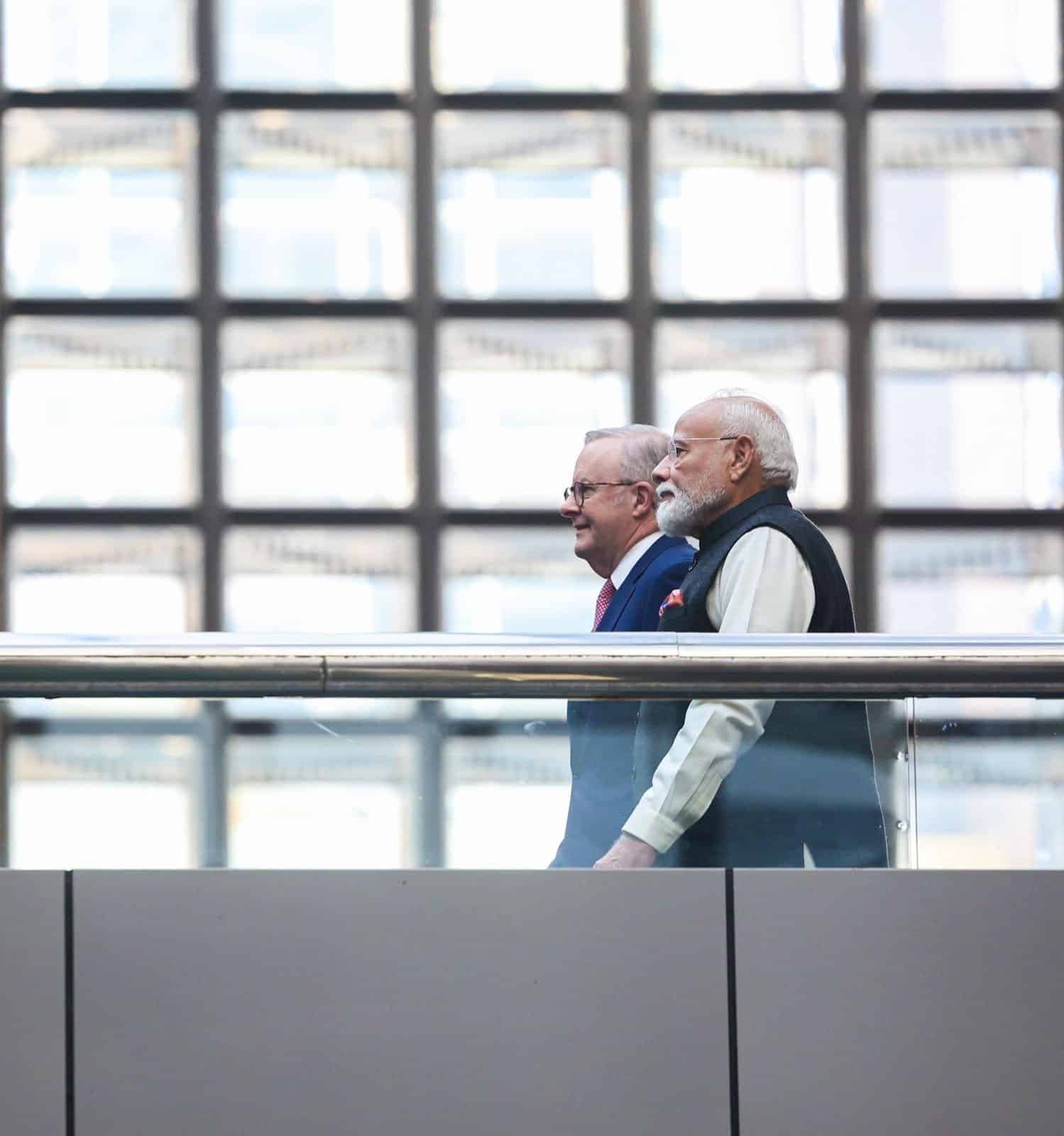
Prime Minister Narendra Modi travelled to Melbourne for the third India-Australia Annual Leaders’ Summit. He and his counterpart Anthony Albanese put their names to a wide package of agreements. The list ran well beyond minerals. It covered civil nuclear energy and uranium supply, defence and maritime security, cyber security, emerging technologies and trade. Officials also agreed to speed up talks on a broader trade pact, the Comprehensive Economic Cooperation Agreement.
Two announcements stood out. First, Australia committed to expanding long-term uranium exports to India for peaceful civilian power generation, under International Atomic Energy Agency safeguards. Second and more consequential for the technology economy, the two countries launched a dedicated India-Australia Critical Minerals Corridor. Earlier deals in this space leaned on soft language and non-binding memoranda. This one comes with a defined scope. It names lithium, cobalt, nickel, gallium, graphite and rare earth elements, the materials that sit inside every electric vehicle, semiconductor and renewable energy system built today. The two governments have aligned on 24 critical minerals as shared priorities. This corridor is meant to encourage exploration, processing and investment and to build supply chains that do not run through a single point of failure.
The shift in tone matters almost as much as the text. For years, cooperation on minerals between the two countries produced plenty of statements and little that anyone could point to on a map. Officials on both sides now talk about named projects and identified funding routes. That marks a change from another framework destined to sit in a drawer. It reflects how urgent the issue has become for both capitals, not a sudden burst of goodwill.
Why Australia and India Fit Together
The partnership works because the two countries sit on opposite ends of the same supply chain, almost by geological accident.
Australia mines the raw material. It is the world’s largest lithium producer, responsible for roughly 52 percent of global output from hard-rock deposits in Western Australia. It also holds substantial reserves of cobalt, graphite, gallium, nickel and rare earths. These are the building blocks of every major clean-technology platform, from lithium-ion batteries to the permanent-magnet motors inside wind turbines and electric vehicles.
India, by contrast, is almost pure demand. Its renewable energy targets call for 500 gigawatts of non-fossil capacity by 2030. Its electric vehicle ambitions aim for 30 percent of new car sales within the decade and its solar manufacturing sector is scaling fast and needs mineral inputs at industrial volume. India has some of its own reserves too. Government estimates put its monazite deposits, a phosphate mineral rich in rare earth oxides, at over 13 million tonnes. That contains an estimated 7.2 million tonnes of rare earth oxides. Yet India currently produces only a handful of critical minerals at scale, held back by limited exploration and thin processing infrastructure. To close that gap, the 2026-27 budget introduced “rare earth corridors” in Odisha, Kerala, Andhra Pradesh and Tamil Nadu, aimed at mining, refining and magnet manufacturing.
The Catch Neither Country Can Solve Alone
Here is the complication that makes this deal necessary rather than merely convenient. Australia can mine the lithium. But turning raw spodumene ore into battery-grade lithium hydroxide is a separate, highly technical step and that refining capacity has historically sat almost entirely inside China. Without it, Australian ore can still end up travelling to Chinese refineries before it ever reaches an Indian battery factory. That leaves the “diversification” only partly real.
That is precisely the gap the new corridor targets. The summit commitment explicitly covers processing and value-addition, not just extraction. It is an attempt to build the missing middle of the supply chain on friendly soil, rather than routing it back through Beijing. China’s dominance was not an accident of geology. Decades of sustained state investment built it, along with a high tolerance for the environmental costs of processing and pricing that made rival refineries commercially unviable. Matching that infrastructure will take years and serious capital. The Melbourne agreements are best read as the starting architecture rather than a finished one.
There is also a cost question that rarely makes the headlines. Building a refinery that can compete with Chinese processing means absorbing higher labour and environmental costs from day one, since Beijing’s price advantage rests partly on standards that democracies are unlikely to match. Any Australian or Indian facility will need patient capital and, in many cases, government backing, simply to stay in business against a competitor that can undercut it whenever it chooses.
Part of a Bigger Pattern
The Australia deal did not arrive in isolation. Over the past few months, India has signed a string of similar pacts. In May 2026, External Affairs Minister S. Jaishankar and Secretary of State Marco Rubio concluded a framework between India and the United States on critical minerals and rare earths, agreed during a Quad foreign ministers’ meeting in New Delhi. On the same visit, the Quad countries, India, the United States, Japan and Australia, launched a joint initiative aiming to mobilise up to 20 billion dollars for mining, processing and recycling projects across the Indo-Pacific. India has also opened a first joint working group on minerals with France and it has struck deals with Indonesian firms on nickel and rare earth magnet manufacturing.
Australia itself has been busy elsewhere too. It has received hundreds of millions of dollars in American financing for cobalt, nickel and other mineral projects, as Washington’s own diversification push accelerates. Zoom out and a pattern appears. Trusted democracies are stitching together a parallel supply chain, deal by deal, that increasingly bypasses China altogether. This is the same logic behind Pax Silica, the American-led pact that treats chips, AI infrastructure and critical minerals as one connected bundle. India signed on to that initiative earlier in the year. The Australia corridor reads as one more brick in the same wall.
Why This Matters Beyond Minerals
Rare earths sound like a niche commodity, but they sit underneath nearly everything that counts as modern technology. They go into the magnets that turn electricity into motion in an electric vehicle. They sit in the sensors on a fighter jet and in the components that support semiconductor manufacturing and artificial intelligence hardware. A country that cannot secure these materials cannot secure the industries built on top of them. That idea connects directly to the broader anxieties driving the global chip war and India’s own push to build semiconductor capacity at home.
For India specifically, geography and ambition sharpen the stakes. It sits in a difficult neighbourhood and wants to scale up electric vehicles and renewable energy fast. At the same time, it is trying to build a domestic chip industry that will need many of these same inputs. A supply disruption in rare earths would not just dent an industry. It would stall the clean energy transition, the EV rollout and the semiconductor push all at once, which is exactly the kind of single point of failure that Melbourne’s agreements are trying to engineer away.
The Honest Limits
None of this changes the balance of power overnight. China still refines close to 90 percent of the world’s rare earths and holds roughly 60 percent of known reserves. That lead took thirty years to build and a handful of summits cannot erase it. Corridors, frameworks and joint working groups are promising architecture, not finished factories. The lithium still needs mines to be dug. Refineries still need to be built. Capital still needs to be spent, patiently, over years, before any of these deals show up as fewer Chinese-refined magnets on the production line.
What Melbourne offers is direction rather than a finished solution. India and Australia have matched the world’s largest lithium producer with one of its fastest-growing consumers. They backed the pairing with a defined list of minerals and a stated intent to build processing capacity and they slotted the whole arrangement into a wider web of similar deals with the United States, Japan, France and others. Each individual agreement looks modest. Together, they describe a slow, deliberate attempt to build a rare earth supply chain that no single government can hold hostage. What gets built and how fast, will decide whether it works, far more than the signing ceremony in Melbourne ever could.