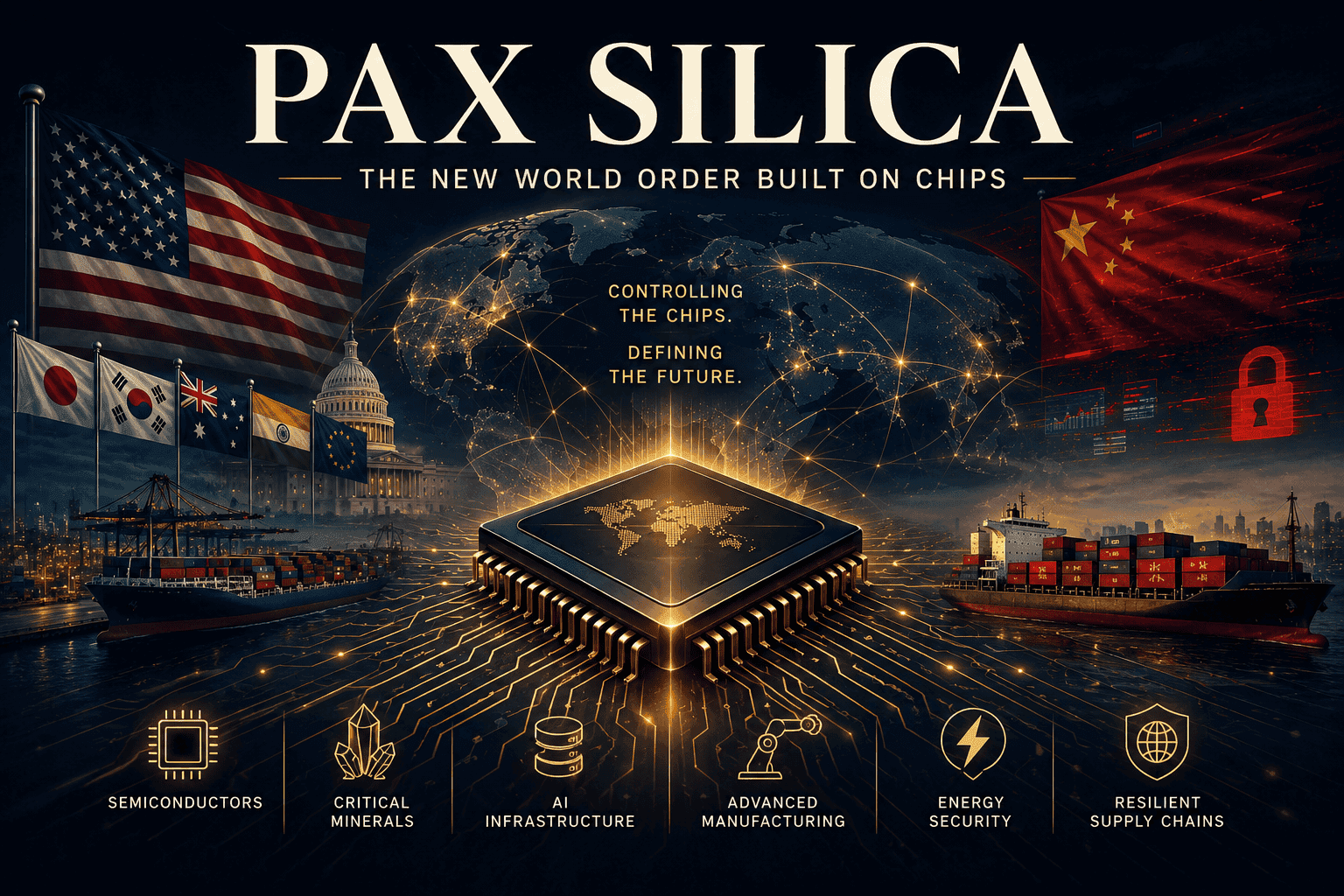
For most of modern history, great powers ruled through hardware you could see. Fleets, armies, oil fields, the steel that built them. Power had a physical address. In the twenty-first century, that address has shrunk to a few atoms of silicon and a new word has appeared to describe the order taking shape around it: Pax Silica.
Historians use the Latin word Pax to describe periods when a single dominant power shaped the international order. Pax Romana captured Rome’s imperial stability. Britain’s naval supremacy gave the world Pax Britannica. After 1945, Pax Americana described the system led by the United States. Pax Silica borrows that tradition but swaps armies and fleets for semiconductors and artificial intelligence.
The phrase rewards a second look. It means, roughly, “the peace of silica”, a deliberate echo of Pax Britannica and Pax Americana, the eras when one power’s navy or economy set the rules for everyone else. The claim behind Pax Silica is simple and unsettling. The country that controls the design, manufacture and supply of the world’s most powerful chips will set the rules of the coming age, the way Britain once did with sea lanes and the United States did with the dollar.
Until recently this was a phrase for analysts and op-eds. In December 2025 it became something far more concrete.
From Metaphor to Pact
On 12 December 2025, the United States gathered a group of partner countries in Washington and launched the Pax Silica Declaration, a flagship effort run by the State Department. The text is non-binding, more a statement of intent than a treaty, yet its ambition is enormous. It tries to knit together the entire technology stack of the AI age under one banner: critical minerals, energy, high-end manufacturing, semiconductors, AI infrastructure and the logistics that move it all.
One line from a senior US official captured the thinking. If the twentieth century ran on oil and steel, he argued, the twenty-first runs on compute and the minerals that feed it. Pax Silica is the attempt to organise the world around that belief and to make sure the organising is done on American terms.
The stated goal is to cut what the declaration calls “coercive dependencies”. In plainer language, that means reducing the world’s reliance on a single supplier for the things modern technology cannot live without and that single supplier is, unmistakably, China. Washington has even put money behind the words, pledging a 250 million dollar fund to shore up critical-mineral and manufacturing supply chains among trusted partners.
Who Is In and Who Is Left Out
A pact like this reveals as much through its guest list as its text. The initial signatories included Australia, India, Israel, Japan, South Korea, Singapore, the United Arab Emirates and the United Kingdom, among others. Each brings a different piece of the puzzle. South Korea holds memory chips. The Gulf states bring energy and capital. Israel offers chip-design depth. India brings something no one else can match, which we will come to shortly.
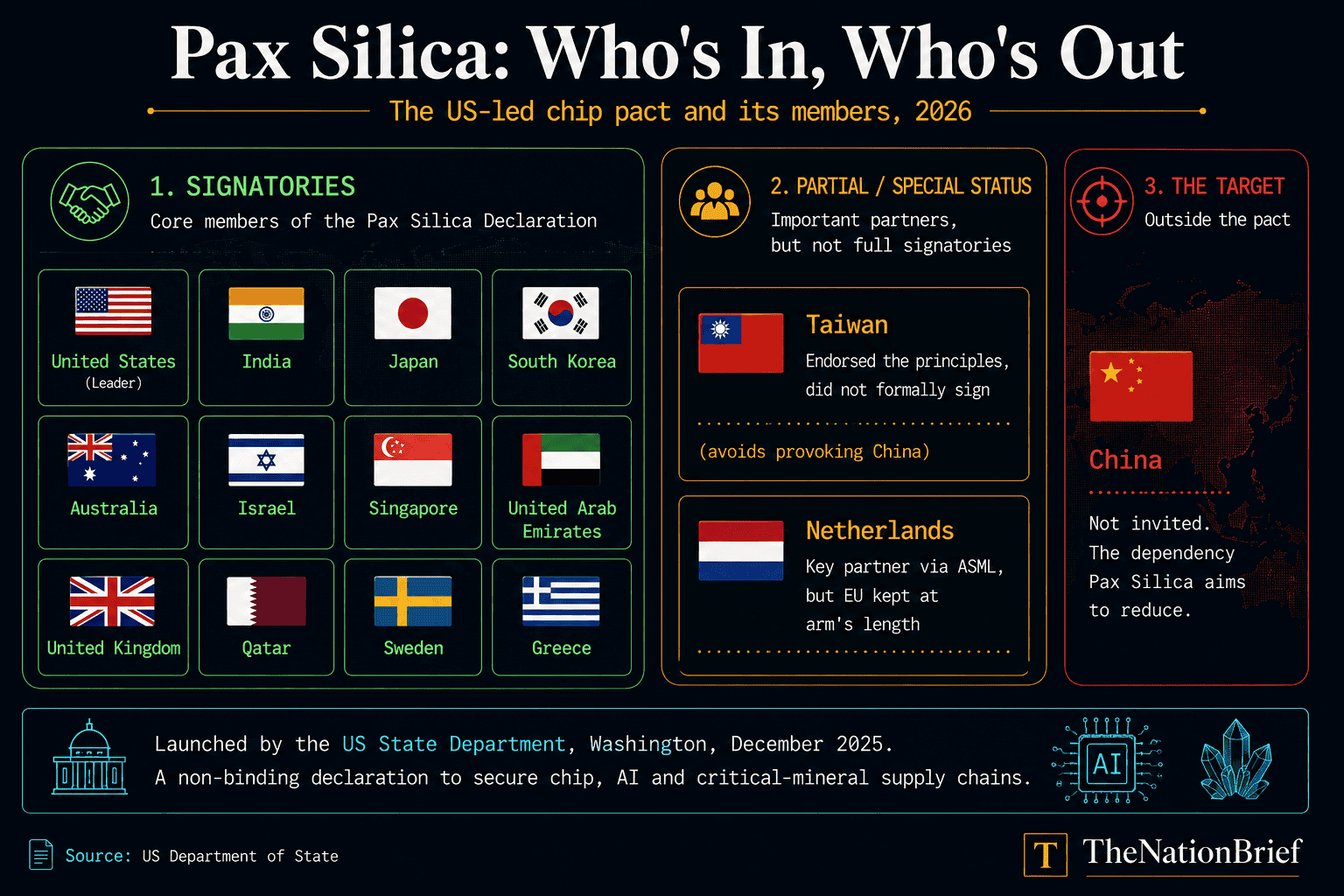
Two absences tell their own story. Taiwan, home to the company that builds most of the world’s leading-edge chips, endorsed the principles but did not formally sign, a careful step that avoids provoking Beijing. The European Union, meanwhile, sits awkwardly on the edge. The Netherlands, home to the lithography giant ASML, is a key partner, yet the bloc as a whole has been kept at arm’s length. Washington has preferred to deal with European capitals one by one rather than through Brussels, a quieter signal that Pax Silica is built for American convenience first.
A New Kind of Power
Pax Silica is not a normal alliance and it is not ordinary industrial policy. Instead, it is an attempt to reorganize global technology around chokepoints that the United States can influence and in doing so to redraw the meaning of alignment itself.
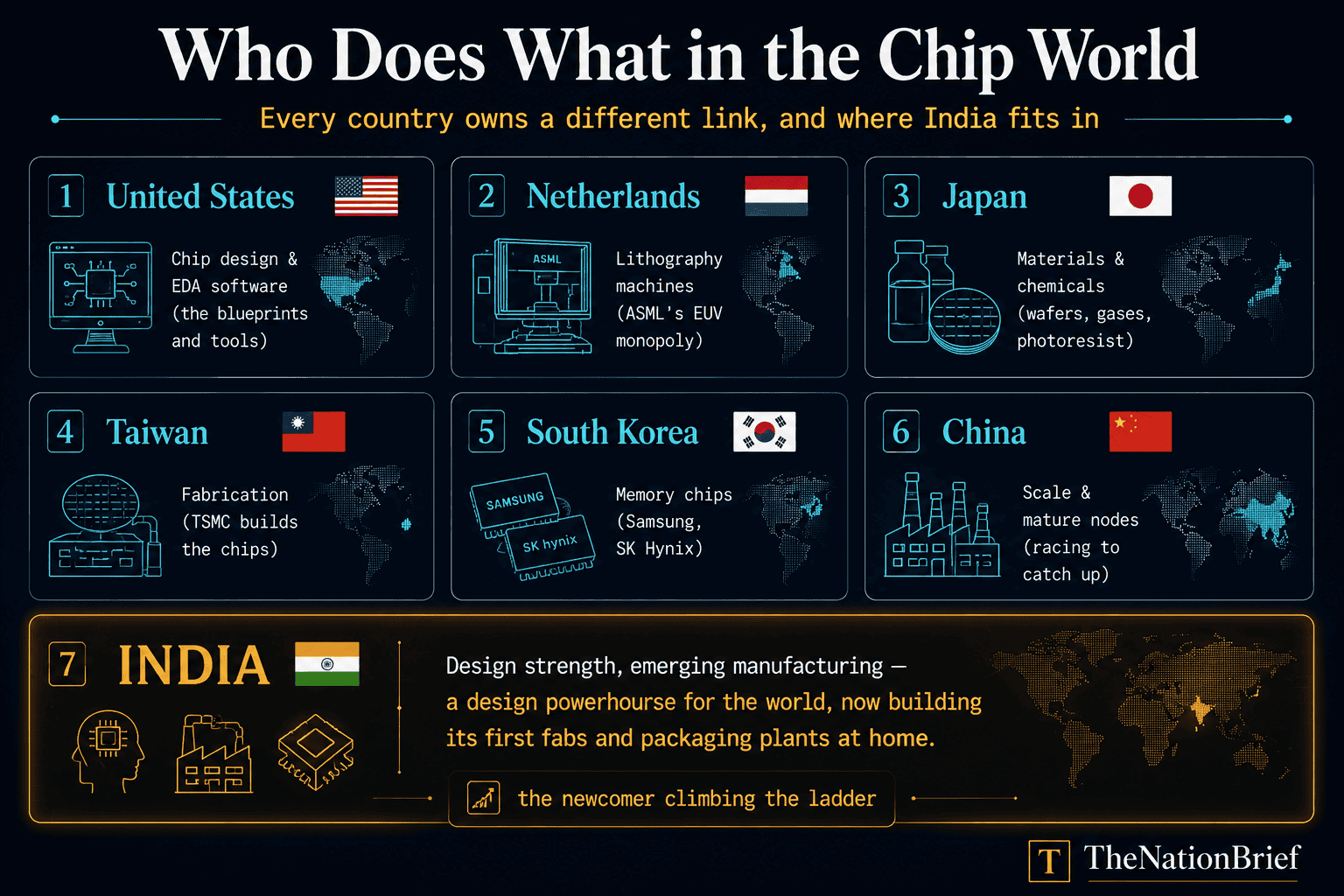
The semiconductor supply chain is uniquely suited to this kind of leverage. After all, no single country can make a cutting edge chip alone. The United States dominates design and software. Meanwhile the Netherlands holds a monopoly on the machines that print chips. Japan in turn supplies rare materials. Taiwan and South Korea do the actual manufacturing. Block any one of these links and the whole chain seizes up, which is exactly what export controls have shown over the past three years. In effect, Pax Silica turns that fragility into a tool of statecraft, sorting the world into those inside the trusted circle and those outside it.
That is also the sharpest criticism of the project. Pax Silica draws a line between allies and clients. Sign on, align with Washington and decouple from Beijing and you gain access to capital, technology and markets. Conversely, stay equidistant and you risk being pushed to the margins of the most consequential industry on Earth. For many middle powers that have spent years balancing between the two giants, that balancing act is becoming harder to sustain.
Where India Fits
For India, Pax Silica is both an opportunity and a test, which is why its signature matters so much.
India’s leverage is unusual. It does not yet make leading-edge chips, but it designs a vast share of the world’s silicon. Roughly a fifth of the planet’s semiconductor design engineers work out of Bengaluru, Hyderabad and Noida. In an order built on chips, that pool of human talent is India’s entry ticket, the “human silicon” that the manufacturing giants cannot easily replicate. India also offers a huge market and the weight of a democratic third pole between the United States and China.
The opportunity is to convert that leverage into a genuine seat at the table. If India’s own chip plans mature, the country could become a trusted manufacturing and design node inside Pax Silica rather than a bystander. This is precisely the bet behind its homegrown push to build fabs and packaging plants under the India Semiconductor Mission.
The risk runs the other way. Critics warn that developing economies which sign such pacts can end up locked into the low-value rungs of the ladder, doing assembly and testing while design and high-end fabrication stay with the wealthy founders of the club. Whether India becomes a true architect of this order or a junior supplier within it will depend on how fast it climbs and how hard it bargains.
Update, July 2026: India’s ties with fellow signatory Japan, deepened at their 16th Annual Summit in July 2026, showing how bilateral partnerships are now folding into this wider order.
Update, July 2026: India has struck a similar minerals partnership with Australia, launching a Critical Minerals Corridor at their third annual summit in Melbourne, another sign of how resource security is becoming central to India’s alignment choices.
The Order Still Being Written
Pax Silica is young, non-binding and contested. Supporters call it a positive-sum partnership that makes the technology world more resilient. Critics see a US-led bloc dressed in the language of cooperation, one that hardens a bipolar split with China at its centre. One American official insisted the initiative is “really not about China, it is about America”, a line that reassures no one on either side of the divide.
What is clear is that the metaphor has hardened into a strategy. Power in this century will flow less from who commands the seas and more from who commands the chokepoints of the chip and AI economy. Pax Silica is the first serious attempt to write the rules of that order. Whether it becomes a durable peace or simply a new fault line is the question the rest of the decade will answer.