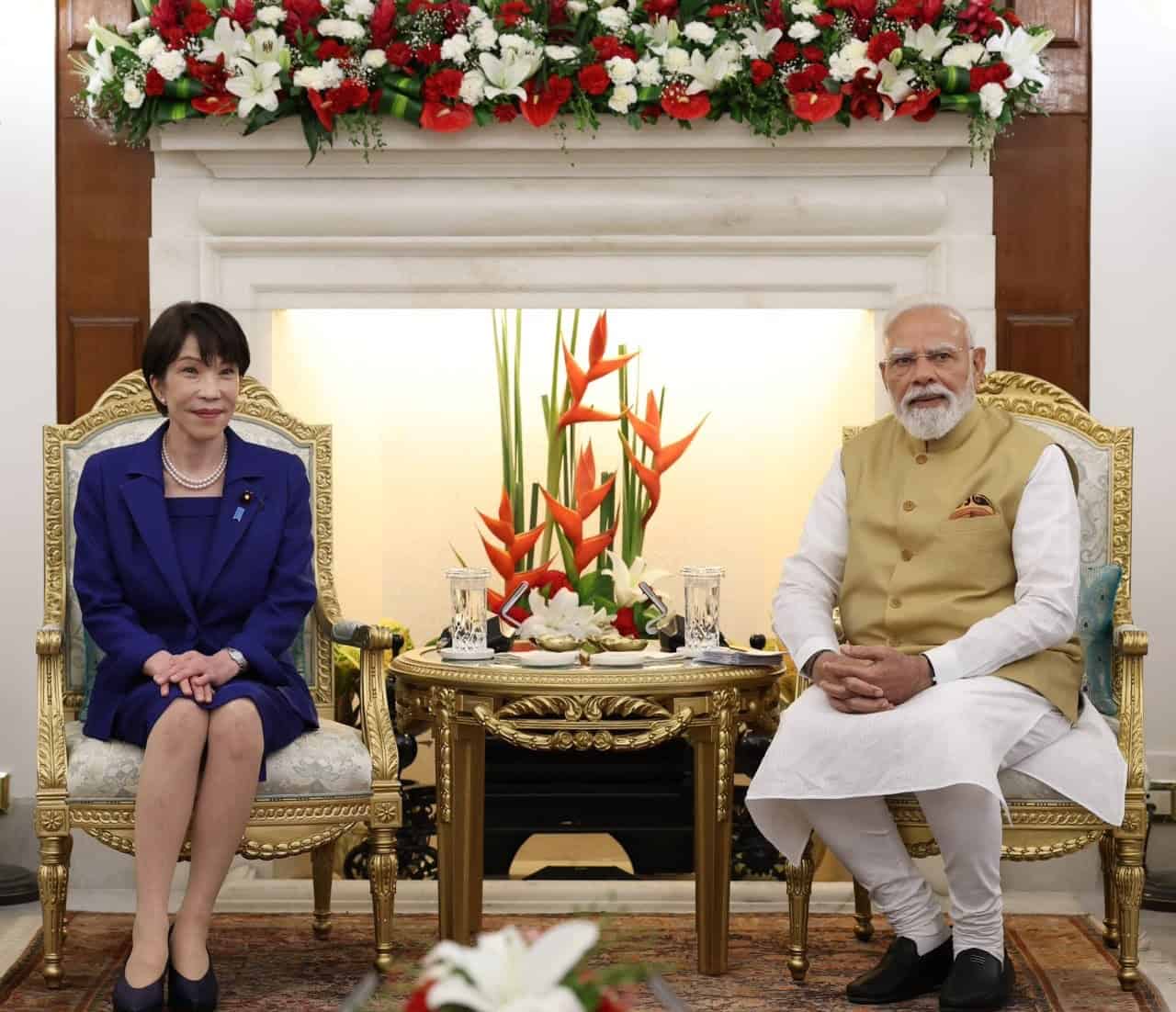
On 2 July 2026, in New Delhi, Japan’s new prime minister Sanae Takaichi sat across from Narendra Modi for the 16th India-Japan Annual Summit. It was her first visit to India since taking office and Modi welcomed her warmly, noting her roots in Nara, a Japanese city with old Buddhist ties to India. The optics were friendly. The substance was heavier. For the first time in their history, India and Japan agreed to build a piece of military hardware jointly. It was a quiet milestone, one that says more about where this partnership is heading than any handshake could.
The Headline: A First Joint Defence Project
The centerpiece was a naval antenna. India and Japan reached agreement in principle on their first defence co-development project, a mast called UNICORN, short for Unified Complex Radio Antenna. It bundles a warship’s many communication aerials into a single sleek structure that reduces the vessel’s radar signature and helps it stay hidden at sea. It will be fitted on Indian Navy ships.
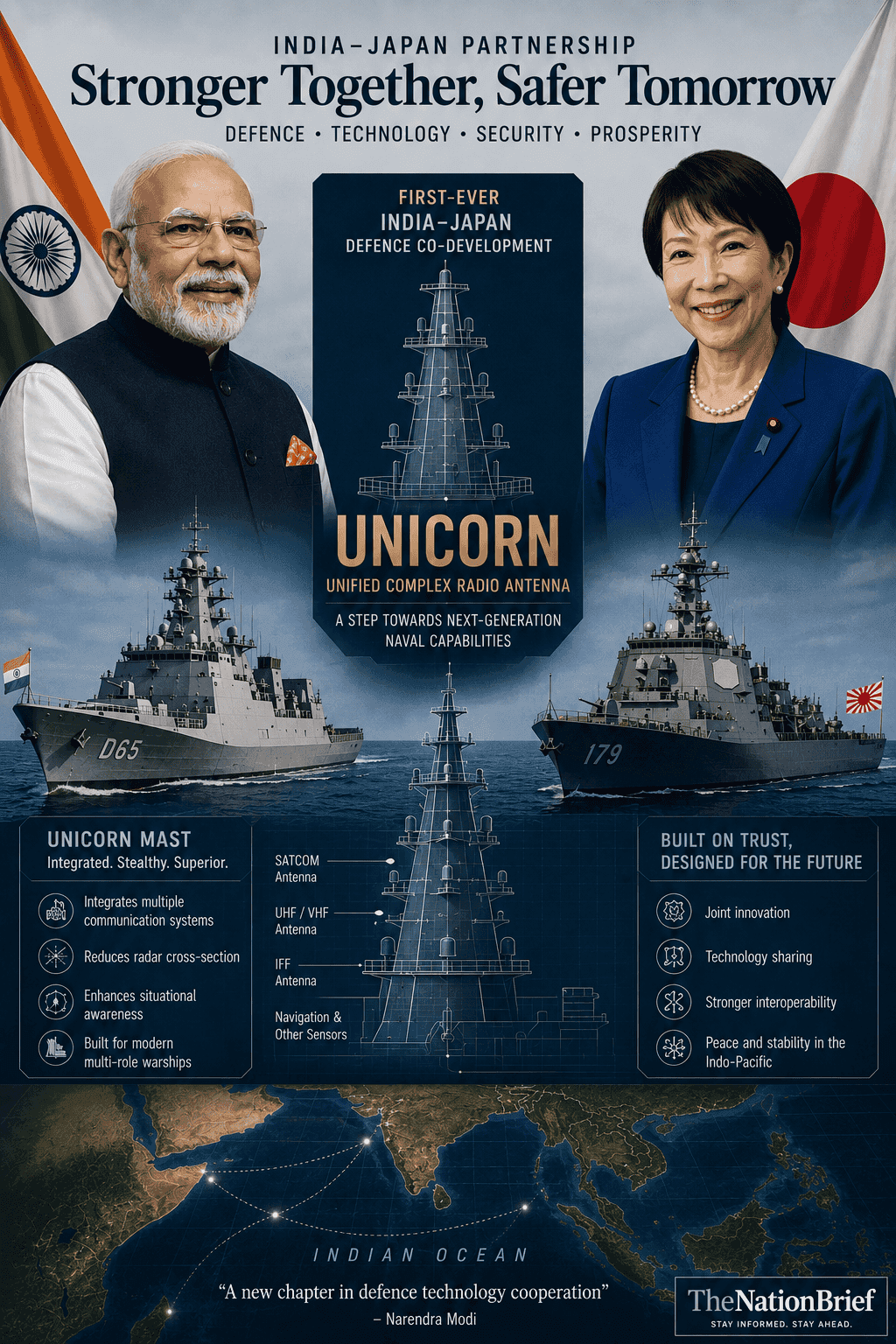
Graphic: TheNationBrief
On paper it is one system. In practice it is a threshold. Until now, India and Japan talked about defence. They held naval drills like Malabar, Dharma Guardian and this year’s JAIMEX 25. Japan is also set to join the International Fleet Review 2026 in Visakhapatnam. Alongside the drills, the two countries also transferred the odd piece of technology. Building a weapon together is a different order of trust. Modi called it “a new chapter” in defence technology cooperation and promised more would follow.
India has long leaned on Russia, France and the United States for co-development. Adding Japan to that short list counts. It widens the circle of partners willing to share sensitive know-how and it plants Japan firmly inside India’s defence-industrial plans. It also fits India’s push to build more of its warships and their systems at home rather than buy them off the shelf. This gives the navy a stealthier mast without deepening its reliance on any single supplier.
Both sides also confirmed that the fourth India-Japan 2+2 Ministerial Dialogue will be held in Tokyo before the end of the year. It is a sign that this defence momentum has a concrete next step already on the calendar.
A bigger prize may be sitting behind it. India has asked Tokyo to consider offering the Kawasaki C-2 airlifter for its Medium Transport Aircraft tender, a contest worth close to a lakh crore rupees. Japan has yet to decide.
Economic Security Is the Real Theme
Beyond the antenna sat the summit’s true organising idea: economic security. Modi and Takaichi adopted a joint roadmap to make their supply chains harder to disrupt, in sectors such as semiconductors, quantum technology, critical minerals and specialised materials. “India and Japan view economic security as a shared security interest,” Modi said.
The timing is not accidental. Conflict in West Asia has snarled shipping routes and raised freight costs and both countries remain heavily exposed to a single dominant supplier for many inputs: China. The roadmap is, in plain terms, a joint plan to de-risk. A fresh agreement between the Geological Survey of India and Japan’s metals and energy security agency will hunt for minerals together. Both sides also share membership of the US-led Pax Silica pact, which pushes trusted partners to build supply chains that route around Beijing. India’s own drive to make chips at home, through its semiconductor mission, fits neatly into this logic.
Technology Becomes the Spine
Technology, more than trade, is becoming the backbone of the relationship. The two governments issued a joint statement on artificial intelligence and several institutions from India’s AI ecosystem signed deals with Japanese partners. The pitch is a neat fit. Japan brings precision engineering and hardware, India brings software talent and scale. “A technology partnership will become the strongest pillar of our cooperation,” Modi said.
There were agreements too on next-generation mobility, batteries, green hydrogen, nuclear energy and an initiative to ride out oil shocks. A clutch of health deals followed as well, covering pharmaceuticals, medical devices and biotechnology. The through-line is clear. This is no longer a relationship built mainly on Japanese cars and bullet trains. It is being rewired around the industries that will decide who leads the next two decades. Taken together, the deals read like a map of the coming economy: chips, minerals, clean energy and AI, the very areas where dependence on a rival can turn into leverage against you.
The Numbers and the Ballast
The commercial base remains solid. Two-way trade reached 27.5 billion dollars in India’s 2025-26 financial year, Japanese investment ran to 3.2 billion dollars in nine months and roughly 1,400 Japanese firms now operate in India, nearly half of them in manufacturing. Japan also bankrolls the Mumbai-Ahmedabad bullet train.
Yet the ballast runs deeper than money. The two countries are marking 75 years of diplomatic ties. Japan is the only partner with a dedicated mechanism to develop India’s North-East. An unusual state-to-prefecture diplomacy has taken root as well, with Indian chief ministers visiting Japan and Japanese governors visiting India, formalised this year in a Governors Network. Few of India’s partnerships carry this much everyday connective tissue, which is part of why the relationship stays steady when others wobble.
Why It Matters: The Indo-Pacific Chessboard
Zoom out and the summit reads as two middle powers bracing for a rougher world. India and Japan both belong to the Quad, alongside the United States and Australia and both want an Indo-Pacific governed by rules rather than raw power. China’s assertiveness at sea worries Tokyo and New Delhi alike. The same contest runs through technology, where the global chip war has already split the world into rival camps and turned supply chains into a front line.
The wider backdrop sharpens the point. Washington has grown more transactional under its current leadership, tariffs and all, which makes any single alliance feel less certain. In that climate, a dependable partner with deep pockets, shared values and no history of coercion is worth a great deal. Modi called the relationship “a vital anchor for regional balance,” and the phrase fits. For Japan, India is a huge market and a democratic counterweight to China. For India, Japan is perhaps its least complicated major partner. This summit turned that mutual convenience into concrete plans.
The Real Headline
Strip away the ceremony and the message of the 16th summit is simple. India and Japan have moved past the era of trade fairs and infrastructure loans. They are now co-developing weapons, securing chip and mineral supply chains together and betting jointly on artificial intelligence. This is what a modern partnership looks like when two economies decide that security and technology are the same conversation. The UNICORN mast is only an antenna. What it signals, a readiness to build the hard things together, is the real headline.