After years of delays, false starts and a failed Indo-Russian joint venture, India’s search for a new medium transport aircraft has entered a decisive phase. In March 2026 the Defence Acquisition Council cleared the Medium Transport Aircraft (MTA) programme. The decision opens the door to one of the largest military airlift acquisitions outside NATO. Reported estimates value the deal at 7 to 10 billion dollars across roughly 60 aircraft. Its aim is twofold: replace the ageing An-32 fleet and strengthen India’s aerospace industry under the Make in India initiative.
That headline scale tells only half the story. Indian factories will build the bulk of the fleet under a Buy and Make structure. The winning manufacturer delivers a smaller batch in flyaway condition. Whichever aircraft prevails will shape Indian tactical airlift for three decades. That is why a contest which crawled for years has suddenly turned urgent.
The story carries an awkward twist. This is the second aircraft to wear the MTA badge. The first was an Indo-Russian joint venture, and it collapsed without a single prototype flying. Understanding that failure explains how the IAF approaches the second attempt. It also explains why the air force is courting four very different aircraft this time.
This guide walks through the whole picture. It covers what the MTA programme is, why the An-32 has run out of road and how the old joint venture died. From there it weighs the four contenders, the Embraer C-390, the Lockheed Martin C-130J, the Airbus A400M and the Ilyushin Il-276, against a requirement that has quietly grown harder to meet.
What Is the MTA Program?
Start with the name, because it has caused real confusion. Two separate Indian projects have carried the MTA label. They are not the same aircraft.
The original MTA stood for Multi-role Transport Aircraft. Hindustan Aeronautics Limited and Russia’s United Aircraft Corporation ran it as a joint development. Work began in the 2000s and drew on the Ilyushin Il-214 design, with both air forces set to co-produce it. The project froze in 2015. India scrapped it the following year.
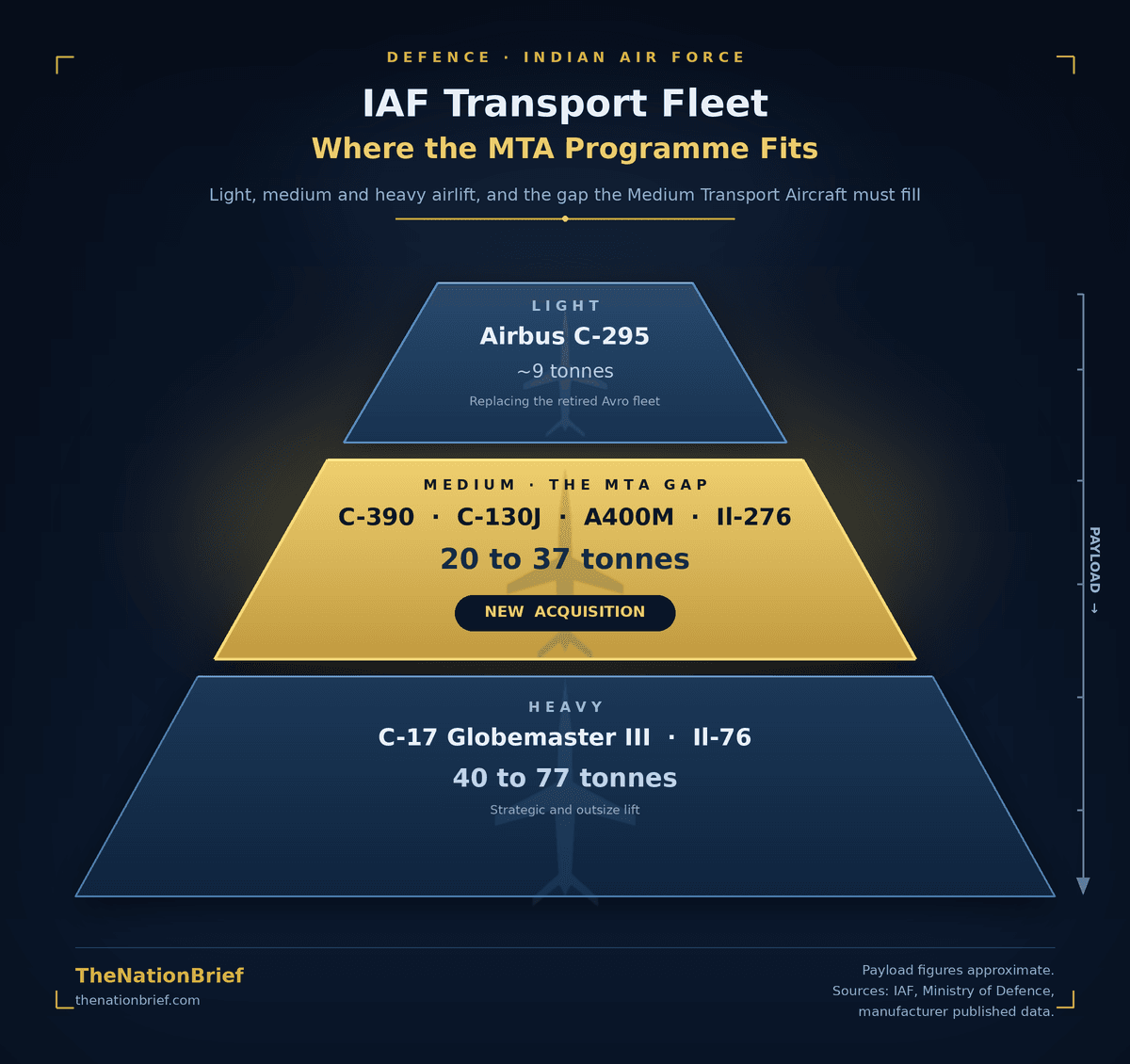
The MTA in today’s headlines stands for Medium Transport Aircraft. This time it is an open international competition, not a bilateral co-development. It answers the same basic need the first programme could not. The IAF wants a tactical airlifter for the middle of its fleet, above the light Airbus C-295 and below the heavy Boeing C-17 Globemaster III and the ageing Ilyushin Il-76.
That middle tier carries most of the day-to-day flying. Medium transports move troops, supplies and vehicles into forward airfields. They drop paratroopers, evacuate casualties and fly relief loads during disasters. They form the backbone of tactical airlift, and they wear out faster than the headline fighters because they fly so much. The programme exists to replace that worn fleet before it fails for good.
Why the IAF Needs the MTA
The case rests on one ageing aircraft above all others. The An-32 has carried the IAF’s tactical airlift load since the mid-1980s. It is now nearing the end of its working life. Replacing it is no longer optional.
Lifeline to the high-altitude frontier
The pressure is sharpest in the mountains. India’s northern and northeastern borders rely on a steady airbridge to high posts that road convoys cannot reach, in Arunachal Pradesh, Ladakh and around Siachen. Much of that lift falls on the An-32. The aircraft is prized for hot and high performance, yet its Soviet-era engineering grows harder to sustain each year. Every airframe retired without a replacement squeezes an already stretched supply line to the frontier.
A second problem sits behind the An-32. The IAF also leans on its Il-76 fleet for heavier lift, and those aircraft are old and maintenance-heavy. A capable medium transport would lift some of that burden, freeing the Il-76s for jobs only a large jet can do. So the MTA must do two things at once. It has to replace the An-32 and relieve the Il-76.
Mobility across two fronts adds urgency. India may have to surge troops and equipment between the western and northern theatres at short notice. That demands airlift it can count on, in numbers, with high availability. Soviet-vintage fleets struggle to deliver it, especially as spares dry up. Which brings us to the most immediate driver of all.
The An-32 Fleet: A Workhorse Running Out of Time
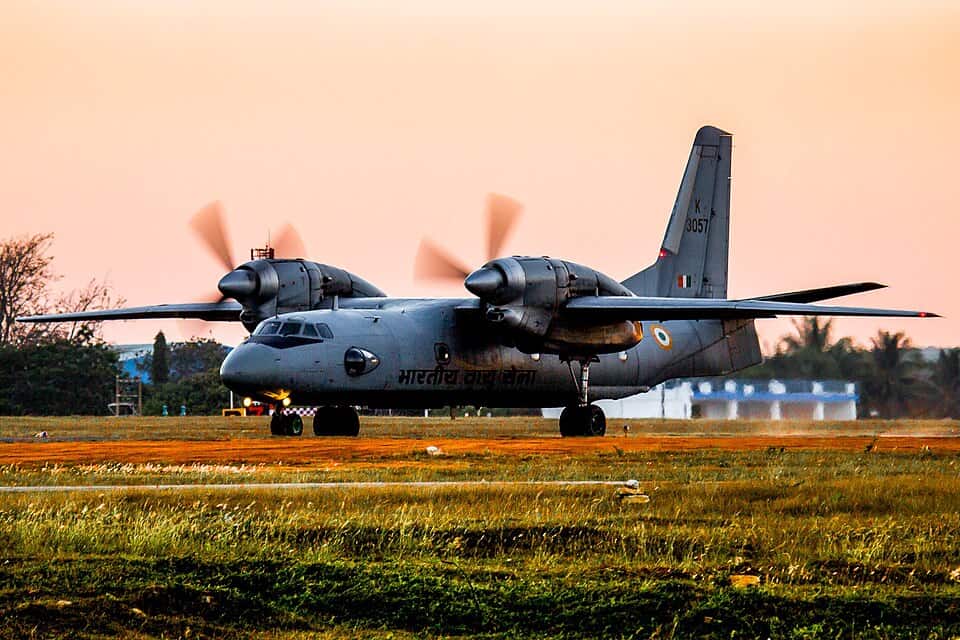
Photo: Damanbir, CC0, via Wikimedia Commons.
India received its first An-32s in 1984. It went on to field one of the largest fleets of the type anywhere, ordering past 100 aircraft. The NATO codename is Cline, though few in the IAF use it. Over four decades the fleet has logged well past eight lakh flying hours. Its safety record is remarkable given the terrain and weather it works in. The aircraft lifts around seven tonnes, uses rough strips and shrugs off heat and altitude that defeat many rivals.
The plan was always to keep it flying through a deep upgrade. A roughly 400 million dollar deal with Ukraine would modernise the fleet to the An-32 RE standard. The work added new avionics, navigation and communications gear and pushed the airframe life toward 2040. The first batch passed through Antonov-certified plants in Ukraine, run by the export agency Spetstechnoexport. Remaining airframes went to the IAF’s Base Repair Depot in Kanpur.
War disrupts the upgrade
War wrecked the timetable. The conflict between Russia and Ukraine, first in 2015 and far more severely from 2022, cut the flow of spares. The upgrade slowed to a crawl. In response, the IAF pulled more of the work in-house. It partnered private Indian firms to overhaul at least 60 aircraft and lift availability above 70 per cent. Officials now talk of flying the An-32 to roughly 2040, with phase-out from around 2032.
Read closely, that timeline is an admission. Stretching a 1980s airframe to 2040 is no vote of confidence. It is a holding action. The IAF expects at least a decade to pass before the first new transports reach squadrons, so the old fleet has to last. Nothing else can do its job yet. That gap, between an aircraft that should retire and a replacement that does not exist, is the hole the MTA must fill.
The First MTA: India and Russia’s Failed Joint Venture
The original Multi-role Transport Aircraft looked promising on paper. India and Russia set up a joint company, with HAL and UAC each holding a stake. Together they committed around 600 million dollars to build a twin-engine jet transport in the 20-tonne class. Early plans tilted production toward Russia. India would take about 45 aircraft and the Russian side around 105, with room for exports and even a civil derivative. Indian assembly would centre on HAL’s transport division at Kanpur.
The design drifted as the two air forces argued over requirements. Engineers reworked the Il-214 baseline to grow the payload and the cargo hold. Those changes pushed the project where no existing Russian engine quite fitted. Each new demand added technical risk. Risk meant longer timelines, higher cost and fading confidence that the aircraft could hit its numbers.
By 2015 the programme had frozen. India walked away in 2016, having spent years and money with nothing flying to show for it. The decision stung. It also taught a lesson the IAF clearly absorbed. Open-ended co-development with a single partner, on an aircraft that exists only as a drawing, is a slow and uncertain road.
From joint venture to Il-276
Russia kept the concept alive on its own terms. The design re-emerged as the Ilyushin Il-276, a medium airlifter carrying around 20 tonnes or 150 paratroopers on the home-grown PD-14 turbofan. Moscow has since offered the Il-276 back to India, now as a contender rather than a partner. The ghost of the first MTA, in other words, is bidding to win the second.
MTA Requirements and Specifications
The IAF frames the requirement around a payload band, not a single figure. Early documents pegged the class at 18 to 30 tonnes. A revised request for information in 2025 raised the ceiling to 30 tonnes. That upper limit matters more than it looks, because of one specific load.
The standout demand is the ability to airlift the Zorawar, India’s new light tank, which weighs around 25 tonnes. A transport that cannot fit a Zorawar loses much of its value for the high-altitude armoured role. This single line reshapes the contest. It sets a hard floor on usable payload and cargo-bay volume that not every contender can clear.
Beyond the tank, the IAF wants the full breadth of a modern airlifter. The aircraft must carry troops, drop paratroopers, haul internal logistics, evacuate casualties and deliver loads by air. It must also work from short or unprepared strips at forward fields. Range and hot-and-high performance feature heavily, given where these aircraft will serve. Several contenders add secondary roles such as aerial refuelling, which the IAF may or may not pursue.
The procurement model matters as much as the flight specification. The programme runs under Buy and Make. A limited number of aircraft arrive built by the foreign manufacturer, while an Indian partner produces the majority at home with technology transfer attached. Reported figures put the home-built share at around 48 of roughly 60 aircraft, though some accounts cite as many as 80. The exact split will firm up with the tender.
Why the Zorawar Requirement Changes Everything
One specification shapes this contest more than any other, and it has little to do with ordinary cargo. The IAF wants its new transport to carry the Zorawar, the light tank built for high-altitude warfare. That demand quietly rewrites the rules.
The Zorawar Factor
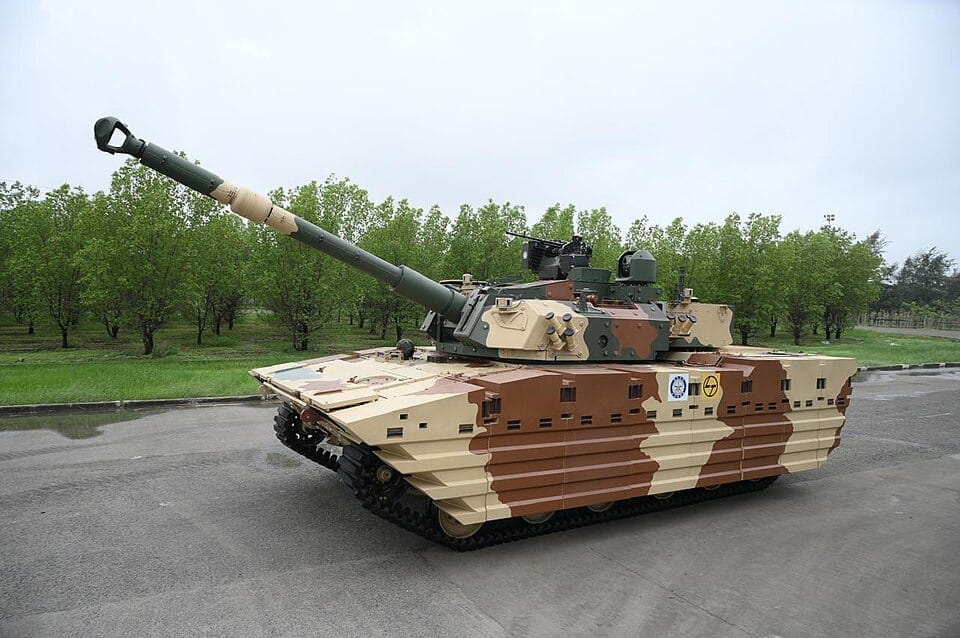
Photo: DRDO / PIB, Government of India, GODL-India.
The Zorawar weighs around 25 tonnes and answers a very particular problem. After the 2020 standoff with China in eastern Ladakh, India needed armour for altitudes and terrain that defeat its heavier tanks. A light tank fits the bill, but only if it reaches the high ground fast. In the mountains, that means moving it by air. The Zorawar airlift capability is therefore no luxury. It sits at the centre of the tank’s whole concept.
That single number, 25 tonnes in the hold, reorders the field. The Lockheed Martin C-130J carries around 20 tonnes and cannot take a Zorawar. For the aircraft the IAF knows best, that is an awkward gap on one of the programme’s defining tasks. The Ilyushin Il-276 hits the same wall at a similar payload. So the requirement pushes the contest toward the heavier aircraft almost by default.
Here the Embraer C-390 gains ground. Its payload near 26 tonnes clears the Zorawar bar, if only just, while keeping jet speed and a modern multi-mission airframe. The IAF can meet the tank requirement without buying the most expensive jet in the field. The Airbus A400M clears the bar with ease, lifting up to 37 tonnes. That margin keeps it in contention despite a cost that otherwise makes planners flinch. The tank, in effect, buys the A400M a seat its price tag might have lost.
Seen this way, the Zorawar requirement is the hidden hand behind the contest. It rewards payload, punishes the cheaper turboprops on their weakest point and forces a trade-off between capability and cost the IAF cannot dodge. Anyone trying to call the winner should start here, not with the top line of the spec sheet.
The Contenders
Four aircraft sit in the frame, and they could hardly differ more. One is a modern jet. Two are turboprops at opposite ends of the size and cost scale. The fourth is a Russian design still chasing maturity.
Embraer C-390 Millennium
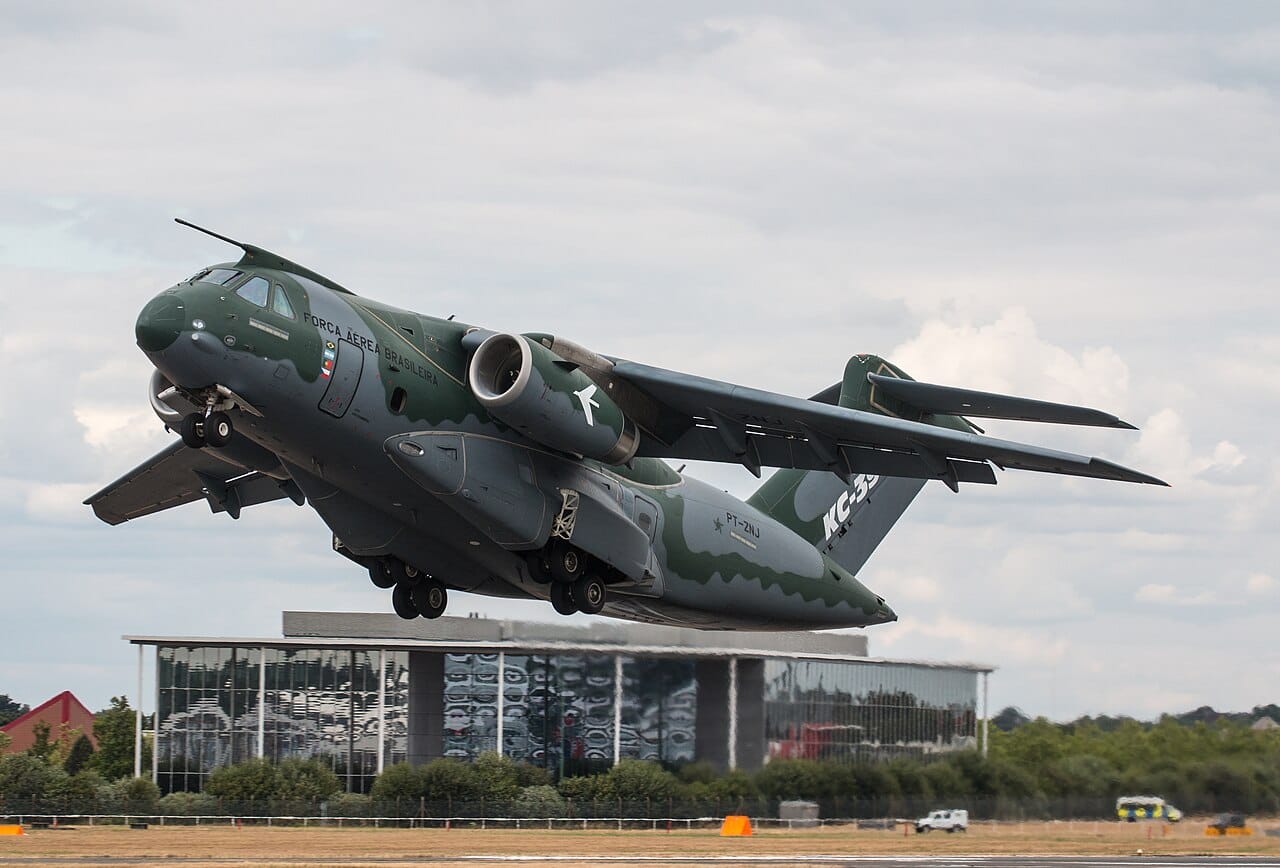
Photo: Steve Lynes, CC BY 2.0, via Wikimedia Commons.
Brazil’s C-390, sold in tanker form as the KC-390, is the newest design and the only jet. It lifts around 26 tonnes, outruns the turboprops and flexes across missions, from aerial refuelling to medical evacuation. Embraer has tied up with the Mahindra Group for a local bid. In early 2026 the partners began scouting Indian sites for production and maintenance.
The C-390’s strongest card may be politics as much as performance. Senior Indian voices, including retired Air Marshal M. Matheswaran, argue that Brazil will share technology more freely than the United States or the big European suppliers. Such a deal, they suggest, could even feed India’s ambition to build its own civil airliner. For a programme built around Make in India, that argument lands.
Lockheed Martin C-130J Super Hercules
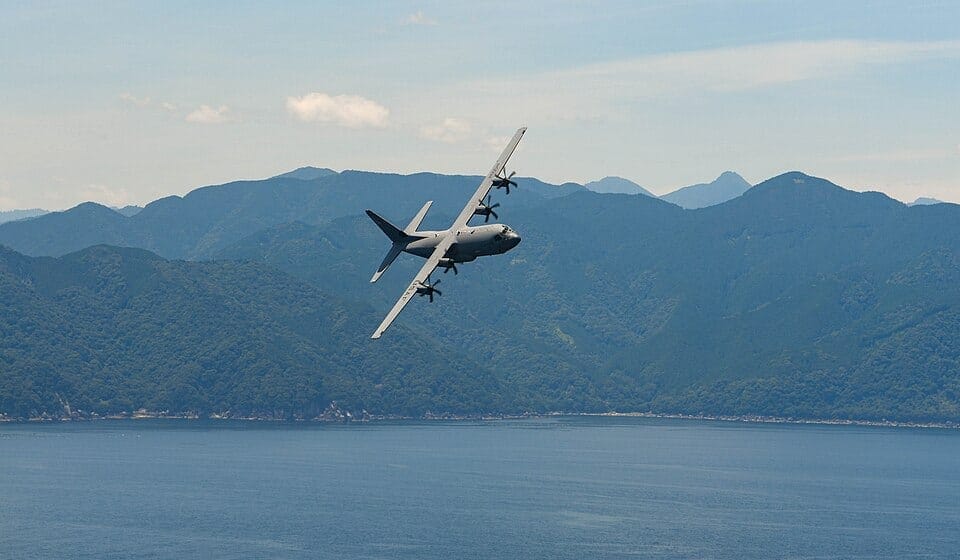
Photo: U.S. Air Force / Senior Airman Natalie Doan, public domain.
The C-130J is the incumbent in spirit. The IAF already flies a dozen for special operations and has come to trust the type. Lockheed Martin has partnered Tata Advanced Systems for any Indian production, and it already supports the in-service fleet with Rolls-Royce, which maintains the AE 2100 engines. Familiarity, reliability and a proven logistics tail all count in its favour.
Then comes the Zorawar problem. The C-130J tops out near 20 tonnes, below the tank the IAF wants to move, which casts doubt over its fit for the headline task. Its basic design dates back to the 1950s. The J-model is thoroughly modernised, yet it offers less room for the deep industrial collaboration India is chasing.
Airbus A400M Atlas
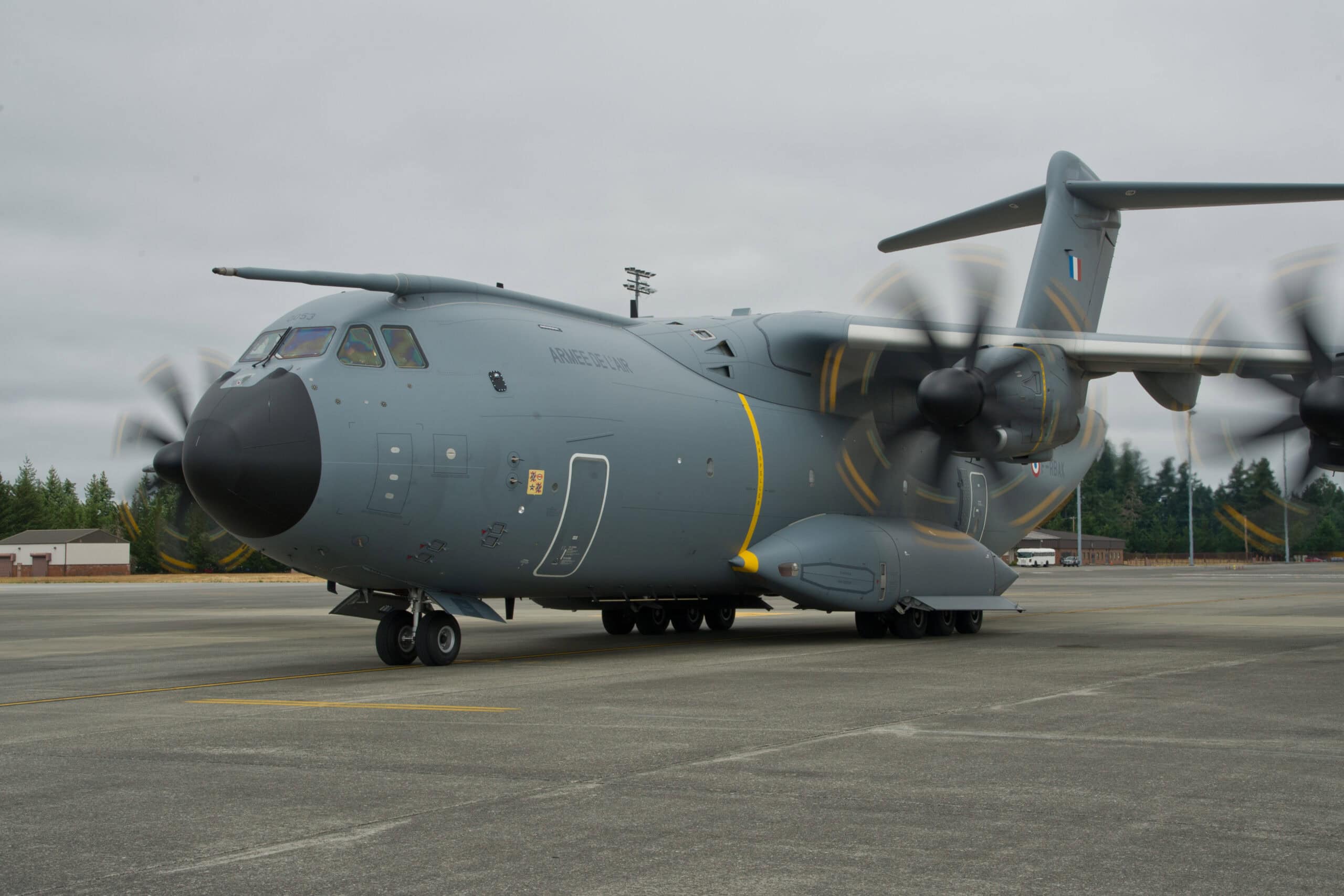
Photo: U.S. Air Force / Staff Sgt. Kyle Brasier, public domain.
The A400M sits at the upper end of the medium-to-heavy spectrum, with a payload of up to 37 tonnes. It pairs that muscle with a glass cockpit, fly-by-wire controls, short-field performance and a built-in refuelling option. It carries loads the others cannot. Airbus also gives it an industrial link to India through the C-295 line with Tata at Vadodara, though no formal A400M bid partnership exists yet.
Capability comes at a price, and there lies the catch. The A400M costs a lot to buy and to run. Several assessments judge it too expensive for the routine medium-lift work that fills most IAF transport sorties. It risks being more aircraft than the role needs. That is an odd charge to lay on a transport, but a real one when the budget must stretch across fighters, helicopters and much else.
Ilyushin Il-276
The Il-276 descends directly from the failed joint venture, now offered to India with HAL. It promises continuity with India’s Russian-built fleets and the maintenance habits around them, carrying about 20 tonnes or 150 paratroopers on the PD-14 turbofan. For a force that has flown Antonovs and Ilyushins for decades, that familiarity counts.
The doubts run deep, though. The aircraft is still chasing full maturity, its timelines have slipped before, and the war in Ukraine clouds the reliability of Russian supply and financing. India has also signalled a preference for a European engine, which Moscow cannot provide. Reports that India will keep working with Russia in 2026 keep the Il-276 alive in the contest. Even so, it carries the most baggage of the four.
Head-to-Head: How the Aircraft Compare
The four contenders separate cleanly once you set their numbers side by side. The table below sums up where each stands on the measures the IAF weighs most, from payload and the Zorawar test to industrial risk and technology transfer.
| Feature | Embraer C-390 | Lockheed C-130J | Airbus A400M | Ilyushin Il-276 |
|---|---|---|---|---|
| Payload | 26 tonnes | 20 tonnes | 37 tonnes | 20 tonnes |
| Cruise speed | 870 km/h (jet) | 640 km/h (turboprop) | 780 km/h (turboprop) | 800 km/h (jet) |
| Range, max payload | 2,800 km | 3,300 km | 3,300 km | 2,000 km (est.) |
| Status | In service | In service, incl. IAF | In service | In development |
| Zorawar compatible | Yes, marginal | No | Yes, comfortable | No |
| India partner | Mahindra | Tata Advanced Systems | Airbus (TASL link, unconfirmed) | HAL |
| Production risk | Low to moderate | Low | Moderate | High |
| ToT potential | High | Moderate to low | Moderate | High on paper, uncertain |
Range figures swing sharply with payload and conditions, so read that column as indicative. The pattern still holds. The jets trade range for speed, the turboprops do the reverse, and only two aircraft clear the tank requirement outright.
Reading the table
Line the four up and the requirement does much of the sorting. On raw payload the A400M leads at around 37 tonnes, the C-390 follows near 26, and the C-130J and Il-276 sit together near 20. Apply the Zorawar filter and the picture sharpens. A 25-tonne tank rules out anything that cannot carry it. The A400M and the C-390 pass that test. The two lighter aircraft fall short.
Cost pulls the other way. The A400M’s capability comes with a buy-and-operate bill that worries planners already juggling big purchases. The C-390, the C-130J and the Il-276 all promise cheaper flying. So the contest narrows to a question the IAF has faced before. Pay more for an aircraft that does everything, or buy enough of a cheaper one that does almost everything?
Technology transfer may settle it. The programme exists to grow Indian aerospace, so the partner that opens its books widest holds an edge the spec sheet cannot show. On that score the C-390 draws the most optimism. The A400M and C-130J meet the usual caution around Western export controls. The Il-276 offers deep collaboration on paper, but against a backdrop of sanctions and supply risk. A mix of aircraft stays possible too, since nothing forces a single winner for every role.
Who Is the Current Favourite?
No contract has been signed, and the IAF has named no frontrunner. Yet the public evidence already points one way. Weighing each contender against the requirement that matters most makes the likely shape of the contest easier to read.
C-390: The Aircraft to Beat?
- Meets the Zorawar requirement on payload
- Already operational with several air forces
- Lower operating cost than the A400M
- Strong technology-transfer potential from Brazil
- Industrial partnership in place with Mahindra
- A mature design carrying little development risk
A400M: The Most Capable Option
- Carries the Zorawar with room to spare
- Best payload in the field at up to 37 tonnes
- Expensive to buy and to operate
- Arguably more aircraft than the routine mission needs
C-130J: Familiar but Constrained
- Builds on an existing IAF fleet and crews who know it
- Backed by an excellent in-country support ecosystem
- Falls short of the Zorawar payload requirement
Il-276: High Risk, High Uncertainty
- Not yet operational
- Shadowed by Russian supply-chain and sanctions concerns
- Carries an uncertain development and delivery timeline
Based on publicly available information, the C-390 currently appears to be the most balanced contender. The A400M still sets the benchmark for raw performance. Familiarity earns the C-130J real credit, yet the Zorawar gap is hard to argue away. The Il-276 would have to clear both its unfinished development and the wider question of Russian supply before anyone could call it safe. None of this guarantees an outcome. Pricing negotiations, strategic partnerships, political considerations and industrial commitments all weigh on a decision this size, and any of them could redraw the picture before a contract is signed.
Update, July 2026: A fourth name has entered the frame. India has asked Tokyo to consider offering Japan’s Kawasaki C-2, a 37.6-tonne airlifter that sits closer to the requirement’s upper end than any of the established contenders.
C-390 vs C-130J vs A400M: Which Aircraft Best Fits India’s Needs?
Strip away the contest and ask a simpler question. Which of these aircraft suits the way the IAF actually flies? The answer turns on which need you weight most, because no single airframe wins on every count.
High-altitude tactical lift
Start with the mountains, the work the An-32 does today. The priority is carrying real loads, the Zorawar included, into demanding airfields. Both the C-390 and the A400M clear that bar. The C-130J, for all its rugged short-field record, cannot take the tank. That one fact narrows the practical choice for the role that drives the whole programme.
Fleet rationalisation and cost
For fleet rationalisation, the maths tilts toward payload. The A400M can absorb missions that now fall to the Il-76, so fewer airframes might cover more ground, though at a steep price. The C-390 offers a softer version of the same logic. It lifts far more than the An-32 without the A400M’s bill.
On affordability and industrial return, the C-390 leads. It promises lower operating costs than the A400M, a jet’s speed over the turboprops and the kind of technology transfer that feeds India’s wider aerospace plans. The C-130J answers with an unmatched support ecosystem and crews already trained on the type.
Put bluntly, the best transport for India depends on the mission the IAF chooses to optimise for. Weight the Zorawar and self-reliance, and the C-390 fits best. Prize raw capability and fleet consolidation, and the A400M makes the stronger case. Focus on cost and continuity alone, and the C-130J stays in the running despite its payload ceiling.
The Make-in-India Dimension
The MTA is as much an industrial project as a military one. Under Buy and Make, the foreign manufacturer ships a first tranche of finished aircraft. An Indian partner then builds the rest at home, absorbing the design and production know-how. The Indian names already circling the programme read like a roll call of the aerospace base: Tata Advanced Systems, the Mahindra Group, HAL and Larsen and Toubro.
This dovetails with a fleet renewal already under way. The C-295 line at Vadodara, a Tata and Airbus venture, is replacing the retired Avro fleet and building a private assembly ecosystem the MTA could use. Add the C-17 heavy lifters and the Il-76s, and a successful MTA buy gives the IAF a clean transport pyramid: light, medium and heavy. A growing share of it would come together on Indian soil.
The prize several advocates keep citing runs bigger than airlift. Master a modern medium transport, with real technology transfer, and India edges closer to building large civil aircraft of its own. The C-390 camp dangles that spillover in particular. It is why partners argue the choice in terms of industrial strategy, not cargo tonnes alone.
Procurement Timeline
The programme crawled for years, then quickened sharply in 2026. A request for information went out in early 2023. A revised version in 2025 lifted the payload ceiling to 30 tonnes. Through late 2025 the Ministry of Defence signalled the formal process was close, with Acceptance of Necessity and a tender to follow.
Two decisive steps came early in 2026. The Defence Procurement Board cleared the proposal on 3 March. The Defence Acquisition Council, chaired by the Defence Minister, cleared the programme on 26 March. Those approvals open the road to a formal tender and, in time, contract talks with the chosen manufacturer and Indian partner.
The induction timeline is sobering. Officials expect at least a decade between contract and the first aircraft in service. That is exactly why the An-32 upgrade now stretches to 2040. The MTA pays off in the 2030s. The decisions taken now will decide whether that payoff arrives on schedule or slips, as the first MTA did.
Strategic Impact
A fleet of 60 or more new transports would reshape Indian airlift well beyond swapping tired airframes. It would restore the mass and availability the An-32 can no longer promise, and sharpen the IAF’s ability to move troops and armour to either front at speed. The overworked Il-76s would get relief too. In a region where mobility to high borders can shape a standoff, that matters.
The humanitarian dividend is real as well. Medium transports do much of the heavy lifting in disaster relief, flying food, water, medical teams and rescue gear into flood and quake zones at home and nearby. A modern fleet with high readiness extends India’s reach as a first responder. That role carries diplomatic weight alongside the military one.
A harder question threads through the programme, and it concerns Russia. The An-32’s troubles and the Il-276’s doubts trace to the same root: dependence on supply chains that war has shown to be fragile. Whichever aircraft wins, the MTA is partly a vote. It asks how far India still wants to anchor its airlift to Russian and post-Soviet engineering, or whether it pivots toward Western and home-grown options.
Is the MTA Really an An-32 Replacement?
Officials pitch the programme as a like-for-like swap for the An-32. The numbers tell a more interesting story. Every contender dwarfs the aircraft it would replace, and that gap raises a question the official framing tends to skip.
| Aircraft | Payload |
|---|---|
| An-32 | 7 tonnes |
| C-130J | 20 tonnes |
| Il-276 | 20 tonnes |
| C-390 | 26 tonnes |
| A400M | 37 tonnes |
The MTA is increasingly evolving beyond a simple An-32 replacement. Several contenders carry two to five times the payload of the Soviet-era transport. That could let the IAF rationalise parts of its fleet and ease the pressure on the Il-76.
The shift carries trade-offs worth weighing. A heavier aircraft can move loads the An-32 never could, the Zorawar and outsize gear that today need an Il-76 or a C-17. Fewer airframes might then cover more of the mission set. But a larger transport costs more to buy, burn and base. It also struggles to match the An-32’s knack for short, rough, high strips. So the IAF is not merely replacing an old aircraft. It is choosing the shape of its medium-lift tier for the next generation, and that shape may look very different from the fleet it retires.
Challenges
The biggest risk is the one the programme already survived once: time. India has a long record of letting transport decisions drift, and the first MTA died of exactly that. Even after the 2026 clearances, a tender, evaluation, negotiation and a decade of production still lie ahead. Any slip widens the gap the An-32 is straining to cover.
Money is the next constraint. The IAF is funding several big buys at once, from the MRFA fighter race to the AMCA stealth programme and fresh talks with Russia over fighters. Sequencing all of it without starving any one project is a real balancing act. A multi-billion-dollar transport competes for the same rupees as everything else.
Supply risk rounds out the list. A Russian choice brings sanctions and reliability worries. A Western choice brings export-control strings. And every option leans on a foreign partner to deliver technology transfer in full, not just in name. Buy and Make is meant to manage these risks. Even so, standing up an Indian transport line, with the tooling, skills and suppliers it needs, is a heavy lift on its own.
Frequently Asked Questions (FAQ)
What is the MTA program?
The MTA programme is the Indian Air Force’s plan to buy a new Medium Transport Aircraft. It will replace the ageing An-32 fleet and relieve the Il-76s. The contest runs as an open international competition under Buy and Make. The Defence Acquisition Council cleared it in March 2026.
How many aircraft will the IAF buy?
Reporting points to around 60 aircraft. Roughly a dozen would arrive in flyaway condition, with the rest built in India. Some accounts cite a requirement as large as 80. The formal tender will confirm the figure.
Which aircraft are competing for the MTA contract?
Four contenders are in the frame. They are the Embraer C-390 Millennium with Mahindra, the Lockheed Martin C-130J Super Hercules with Tata Advanced Systems, the Airbus A400M Atlas, and the Ilyushin Il-276 with HAL.
Why did the original India-Russia MTA fail?
The first MTA was a Multi-role Transport Aircraft from HAL and Russia’s UAC, based on the Il-214. It piled up technical risk as requirements grew. Rising cost, slipping timelines and engine problems pushed India to freeze it in 2015 and abandon it in 2016.
When will the MTA enter service?
Officials expect at least ten years between contract and the first squadron aircraft. That places likely induction in the 2030s. To cover the gap, the IAF is upgrading the An-32 to fly until around 2040.
Will the MTA be made in India?
Yes. The programme runs under Buy and Make. An Indian partner will assemble most of the fleet at home, with technology transfer from the foreign manufacturer, in step with the Make in India push.
Conclusion
After two decades of stops and starts, the MTA programme has reached the point of decision. The March 2026 clearances set a real competition in motion. Four very different aircraft now chase one of the largest airlift contracts going anywhere outside NATO.
The stakes are easy to state. The An-32 is worn out, propped up by an upgrade that war keeps disrupting, while the Il-76s are stretched thin. And the borders that depend on Indian airlift leave no room for a gap. The MTA must close that gap, restore mass to the fleet and build an industrial base that could one day reach beyond military cargo aircraft.
Execution is the hard part. The first MTA failed not for want of need but for want of delivery, and the second will face the same test. Its Zorawar requirement has already narrowed the field, and cost and technology transfer will narrow it further. What remains is a timeline with little room for the drift that has dogged Indian procurement before. Convert this clearance into aircraft on the ramp by the mid-2030s, and the IAF fixes a weakness it has tolerated far too long. Fail, and the An-32 keeps flying on borrowed time while the country waits on a third attempt.