India’s transport fleet has a hole in the middle of it and the hole keeps widening. More than a hundred An-32s are flying well past the age at which spares became a scavenger hunt. Fourteen Il-76s remain serviceable and they start retiring around 2030. At the top sit eleven C-17s, magnificent and far too few. At the bottom, the new C-295s are arriving, useful for nine and a half tonnes and not a kilo more.
Everything in between is the problem. Filling it is what the Medium Transport Aircraft programme exists to do: sixty aircraft, twelve flown in and forty-eight built in India under technology transfer, a package running towards a lakh crore rupees. The Defence Acquisition Council has cleared it. A tender is expected before the year turns.
The Requirement Kept Growing
Here is the part most coverage misses. The MTA has not stood still while the paperwork moved.
The original brief asked for something in the eighteen to thirty tonne class, a straight swap for the An-32. Then planners looked at the Il-76 retirement calendar and asked an awkward question. Why run two competitions when one aircraft, sized right, could absorb both fleets? Reporting from defence circles suggests the requirement has drifted upward towards thirty-five or forty tonnes, which quietly rewrites the contest.
At that weight the familiar names start to strain. The C-390 Millennium carries around twenty-six tonnes, fast and modern but built for the older brief. The C-130J is a superb tactical aircraft the Air Force already knows, though nobody buys a Hercules to replace an Il-76. That leaves the A400M, capable of thirty-seven tonnes and priced at over two hundred million dollars a copy, which makes it an expensive way to move rations to Leh.
Enter the C-2
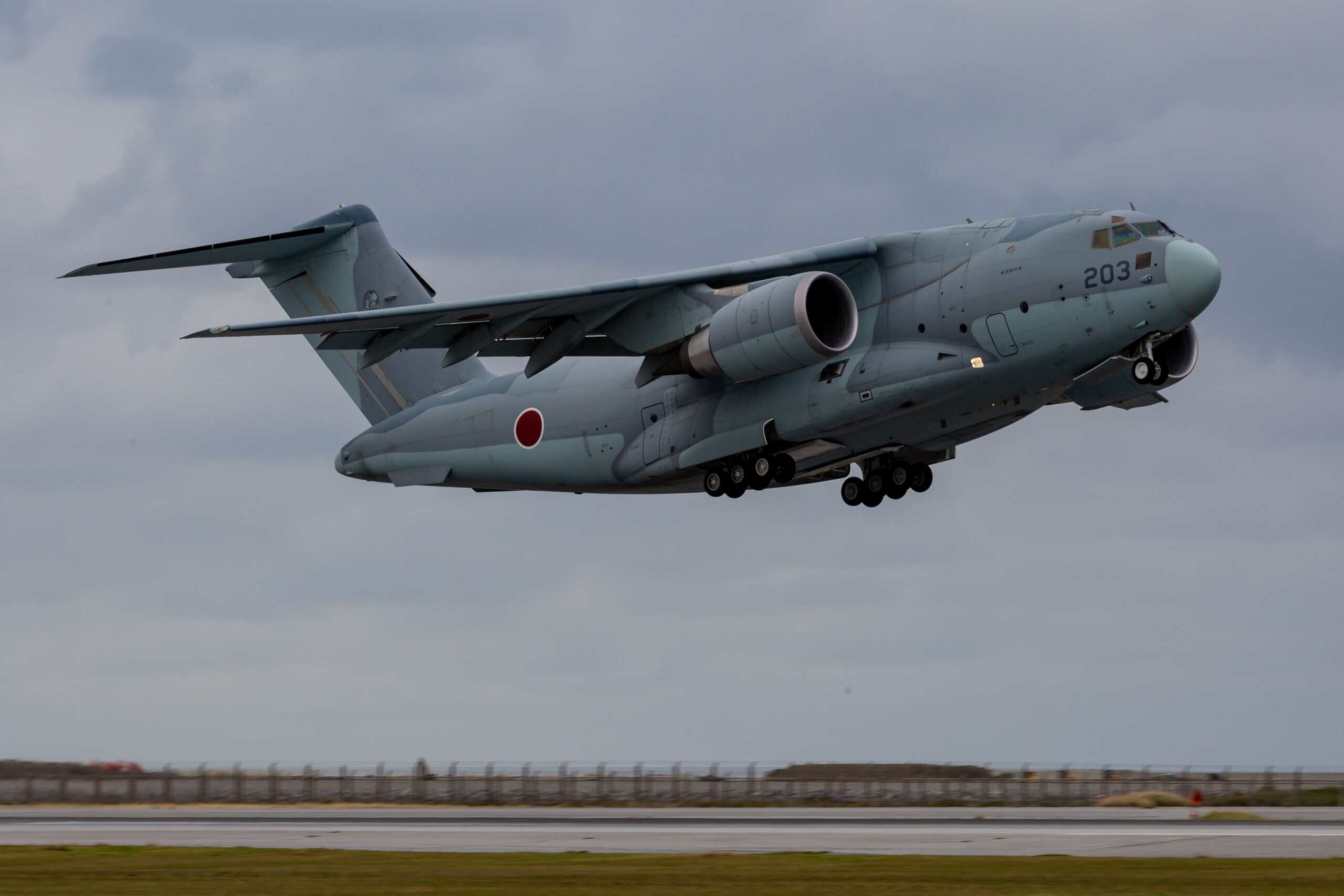
Kawasaki’s C-2 walks into exactly that gap. It lifts 37.6 tonnes, matching the A400M and it does the job with two turbofans instead of four turboprops. That choice shows up in the numbers. Carrying thirty tonnes, the C-2 flies about a quarter further than the A400M and roughly fourteen per cent faster, cruising near 890 kilometres an hour with a ceiling of 40,000 feet.
For a country whose logistics run from Leh to Car Nicobar, speed is not vanity. It is sorties per day. An aircraft that reaches the Andamans faster and returns sooner does more work with fewer airframes, which matters when the fleet is thin and the map is enormous.
The rest of the aeroplane is thoroughly modern. Fly-by-wire controls, a glass cockpit, an automated loading system, a ramp that opens in flight, self-protection suites and a tactical flight management system built for hugging mountainous terrain. It swallows 120 troops, eight pallets or a medium helicopter whole. In service with the Japan Air Self-Defense Force since 2017, it is a flying aircraft, not a brochure.
The Tokyo Factor
Then there is the seller. India asked Japan for a formal proposal back in May 2025 and Indian officials have since nudged Tokyo to enter the race properly. Japan has not yet said yes.
It should. Delhi and Tokyo have just crossed into joint weapons development with the UNICORN naval mast, agreed at their sixteenth annual summit in July. Japan is hunting for its first serious defence export and India is the largest transport competition on the planet. A partner with no history of coercion, no sanctions risk and every reason to be generous on technology transfer is worth something in a decade when suppliers have proved fickle.
The Honest Ledger
None of this makes the C-2 a shoo-in. Its unpaved-strip performance is the open question, since that requirement was trimmed during development and India’s Advanced Landing Grounds in Ladakh and the Northeast are unforgiving classrooms. Japan has never run a large export support chain and a fleet of sixty needs spares flowing for thirty years. Kawasaki has never built anything under licence in India.
Those are answerable questions and the tender exists to answer them. The unanswerable one is whether Tokyo turns up at all. India has opened the door about as far as protocol allows. Japan has an aeroplane that fits the hole in India’s fleet almost suspiciously well. Someone in Tokyo now has to decide whether Japan wants to be an arms exporter or merely capable of being one.