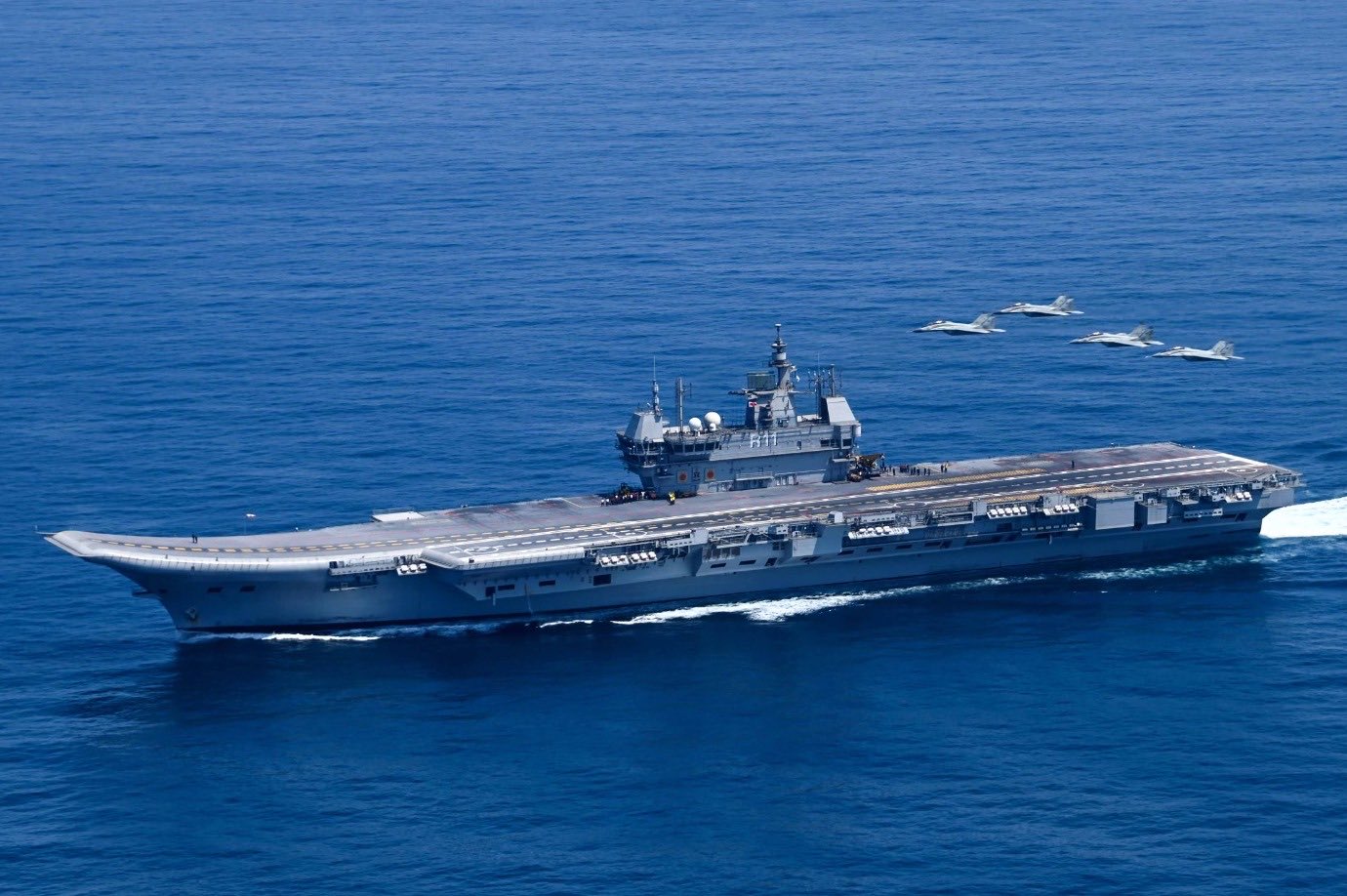
A deep dive into the doctrine, the bases, the rivalry with China and the fleet that will define India’s maritime century.
India’s maritime doctrine has changed beyond recognition in a single decade. For most of its independent history, India treated the sea as a flank to be guarded rather than a domain to be commanded. That assumption no longer holds. The Indian Ocean has moved from a strategic backwater to one of the most contested spaces on the planet, and New Delhi has spent the last decade building the doctrine, the diplomacy, and the hardware to shape it. Anyone trying to understand India’s wider rise has to start here, on the water.
This is a long game, and it deserves to be taken seriously. The Indian Ocean carries the bulk of the world’s energy trade and a vast share of India’s own. Roughly 95 percent of India’s external trade by volume, and around 77 percent by value, moves across these waters. The arteries that feed the Indian economy run through a handful of narrow chokepoints: the Strait of Hormuz, the Bab-el-Mandeb at the mouth of the Red Sea, and the Strait of Malacca to the east. Whoever can threaten those passages can threaten India itself. That single fact explains almost everything about the strategy that follows.
India’s maritime doctrine: from a sea to an ocean
India’s modern maritime vision has a clear starting point. In March 2015, during a visit to Mauritius, Prime Minister Narendra Modi laid out a doctrine he called SAGAR, short for Security and Growth for All in the Region. The acronym also means “sea” in Hindi, and the wordplay was deliberate. SAGAR framed India not as a hegemon but as a “net security provider”, a country that would patrol sea lanes, train partner navies, deliver disaster relief, and build trust across its maritime neighbourhood. It also offered an alternative to the more transactional infrastructure diplomacy spreading across the region.
A decade later, India widened the frame. In March 2025, again on Mauritian soil, Modi announced MAHASAGAR, or Mutual and Holistic Advancement for Security and Growth Across Regions. The name escalates the metaphor from “sea” to “great ocean”, and the substance escalates with it. Where SAGAR concentrated on India’s immediate neighbourhood, MAHASAGAR stretches the canvas to the wider Global South: the western Indian Ocean, the African littoral, the island states, and Southeast Asia. External Affairs Minister S. Jaishankar has described it as a fusion of security cooperation with economic connectivity, sustainable development, and technology partnership. In other words, maritime stability can no longer be separated from trade resilience, climate stress, and supply-chain security.
India’s maritime doctrine in 2025: formalising ‘No War, No Peace’
The doctrinal architecture grew firmer at the end of 2025. On 2 December, the Chief of the Naval Staff, Admiral Dinesh K. Tripathi, released the Indian Maritime Doctrine 2025, the Navy’s first such revision in sixteen years. It introduced a formal “No War, No Peace” operational category, a direct response to the grey-zone tactics that now blur the line between peacetime and conflict at sea. It also emphasised multi-domain operations and prioritised emerging technologies. In a quiet but telling shift, the document leaned toward calling India a “preferred security partner” rather than the older “net security provider”. Analysts read that change as a more realistic accounting of what India can deliver, anchoring the rhetoric to the actual reach of the fleet.
The operational arm: India as first responder
Doctrine means little without ships in the water, and here India has a long record to point to. Since 2008, the Indian Navy has run near-continuous anti-piracy patrols in the Gulf of Aden, escorting merchant vessels of every flag through one of the world’s most dangerous transit corridors. In June 2019, after a wave of tanker attacks in the Gulf of Oman, India launched Operation Sankalp, Sanskrit for “resolve”, to protect shipping across the Persian Gulf, the Strait of Hormuz, and the surrounding waters.
When Houthi attacks and a resurgence of Somali piracy threw the Red Sea region into crisis through 2023 and 2024, Operation Sankalp grew into one of the largest sustained naval deployments in India’s history. The headline moment came in March 2024, when the destroyer INS Kolkata recaptured the hijacked, Malta-flagged bulk carrier MV Ruen, took 35 Somali pirates into custody, and freed 17 crew members. It was the first major hijacking in the region since 2017. The operation showcased more than resolve. Stealth destroyers, ship-launched drones, marine commandos, and MQ-9B SeaGuardian surveillance aircraft all worked in concert. For New Delhi, the message ran two ways: India would act as a first responder when others pulled back, and its naval modernisation was finally producing results.
The infrastructure footprint
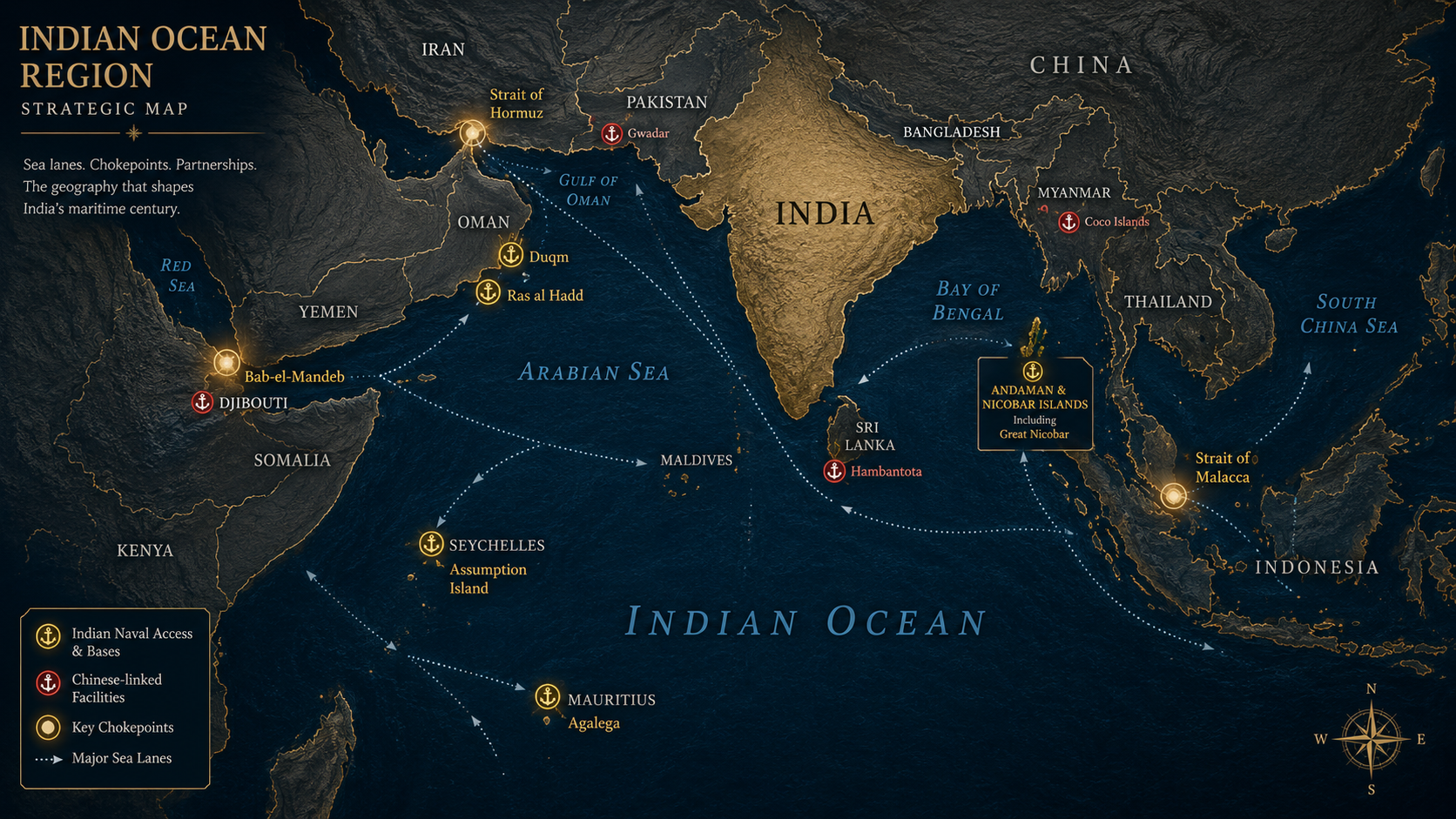
Map: TheNationBrief
A blue water posture needs places to refuel, repair and watch from. Over the past decade, India has quietly assembled a network of access points and listening posts that extend its reach across the western Indian Ocean.
In Oman, India secured access to the strategically placed port of Duqm for logistics and maintenance, giving its warships a foothold near the Gulf of Aden and the approaches to the Red Sea. India also operates a listening post at Ras al Hadd, positioned across the Arabian Sea from Pakistan. Further south, in Mauritius, India financed and built infrastructure on North Agalega Island, including a runway of around three kilometres and a deep-water jetty, at a reported cost near 250 million dollars. Both governments publicly describe Agalega as civilian infrastructure that benefits the islanders. Even so, its location plugs a real surveillance blind spot for India in the southwest Indian Ocean and the Mozambique Channel. New Delhi has pursued similar arrangements with Seychelles on Assumption Island. Together, these footholds let India project air and naval patrols far from its own shores.
The China challenge
None of this is happening in a vacuum. The defining dynamic of the contemporary Indian Ocean is the steady expansion of China’s presence, and much of India’s strategy reads as a response to it.
China’s so-called “String of Pearls”, a web of ports and facilities ringing the Indian subcontinent, is the most visible expression of this. It runs from Gwadar in Pakistan to Hambantota in Sri Lanka and onward to investments along the African coast. In 2017, Beijing opened its first overseas military base in Djibouti, on the northwestern edge of the Indian Ocean. Officially a logistics facility, it now boasts berthing capable of hosting large combatants and submarines. The People’s Liberation Army Navy keeps a roughly constant presence in the region, and Indian planners have tracked an average of several PLA Navy assets in these waters every month in recent years.
China’s “research” and survey vessels worry New Delhi most of all. Ships such as those in the Xiang Yang Hong series gather oceanographic data with clear dual-use value for future submarine operations. Their port calls in Sri Lanka and the Maldives have repeatedly triggered diplomatic friction, and at India’s urging Colombo imposed a temporary moratorium on such docking in 2024. The underlying logic is simple and uncomfortable: a survey today enables a submarine deployment tomorrow. Because the Indian Ocean is far less monitored than the western Pacific, it could become a comfortable operating ground for Chinese subsurface assets.
India’s longer-term answer to this contest is partly economic, taking shape in deep-water trade infrastructure such as the Vadhavan port project on the Maharashtra coast, built to keep Indian cargo on Indian-controlled terminals rather than at foreign hubs.
The cooperative architecture
India’s answer to China’s footprint has not been to match it base for base. Instead, New Delhi has built something Beijing has struggled to replicate: a web of consultative partnerships among the region’s own states.
The centrepiece is the Colombo Security Conclave, or CSC. What began in 2011 as a modest trilateral between India, Sri Lanka, and the Maldives went dormant, then revived in 2020 and grew into one of the most significant security platforms in the region. Bangladesh became a full member in 2024, Mauritius joined the core group, and Seychelles has been moving toward full membership. When India hosted the seventh National Security Adviser level meeting in New Delhi in November 2025, NSA Ajit Doval chaired it. Widely regarded as the Conclave’s architect, Doval watched members reaffirm cooperation across five pillars: maritime safety and security, counter-terrorism, the fight against trafficking and transnational crime, cyber security and critical-infrastructure protection, and humanitarian assistance and disaster relief. Throughout, he has framed the CSC as inclusive and consultative, drawing a pointed contrast with more transactional models of regional influence.
A broader architecture surrounds the CSC. The Indian Ocean Naval Symposium, which India chaired from 2021 to 2025, serves as the region’s premier naval forum. The biennial MILAN exercise, hosted by the Indian Navy, drew more than fifty navies to its 2024 edition, the largest gathering of its kind. India has also concluded “white shipping” agreements with over twenty countries to share real-time merchant-vessel data, and it runs the Information Fusion Centre for the Indian Ocean Region in Gurugram, a hub that pulls together maritime information from across the region. The strategic logic stays consistent throughout. In an ocean too vast for any single navy to watch, the country that builds the best shared picture wins influence.
The Quad factor
India’s regional partnerships feed into a larger framework: the Quadrilateral Security Dialogue, better known as the Quad, which links India with the United States, Japan and Australia. The grouping traces its origins to coordination after the 2004 tsunami and a short-lived 2007 initiative, yet it found real momentum only after 2017. Today it works as a loose, consultative partnership rather than a formal alliance and that distinction matters to New Delhi, which guards its strategic autonomy carefully.
In practice maritime security sits at the core of what the Quad actually does. Its flagship military activity for instance, is the Malabar exercise which started in 1992 as a bilateral drill between India and the United States. Japan joined permanently in 2015, Australia followed in 2020 and over time the exercise has become a full Quad event. Moreover, recent editions have grown considerably in scale, folding in anti-submarine warfare, carrier operations and air defence drills. Most recently the 2025 round was held near Guam in the western Pacific, with the Indian frigate INS Sahyadri taking part.
Watching the blind spots: IPMDA and shared surveillance
Beyond the drills the Quad has built tools aimed squarely at the Indian Ocean’s blind spots. The Indo-Pacific Partnership for Maritime Domain Awareness, launched at the 2022 Quad summit in Tokyo, feeds near-real-time satellite tracking data to partner states across the Pacific Islands, Southeast Asia and the Indian Ocean. Its purpose is to expose “dark shipping”, meaning vessels that switch off their transponders to move unseen, a tactic closely tied to illegal fishing and grey-zone activity. The partners formally extended the initiative to the Indian Ocean Region in 2024.
Newer efforts have followed in quick succession. India hosted the first MAITRI training workshop in 2025, helping smaller littoral states make better use of the data these initiatives generate. The four partners also launched the Quad-at-Sea Ship Observer Mission in 2025, the first joint operation to bring together the coast guards of India, Japan, and the United States alongside the Australian Border Force. For India, the appeal is plain. The Quad multiplies its reach without binding it to anyone, and it puts shared surveillance at the centre of regional cooperation, exactly where India believes its advantage lies.
The eastern anchor: Andaman and Nicobar
If the western Indian Ocean is about access and partnerships the east is about geography that India already owns. The Andaman and Nicobar Islands, an arc of 836 islands stretched across the Bay of Bengal, sit astride the western approaches to the Strait of Malacca one of the busiest and most strategically loaded waterways on earth. Around 60 percent of China’s trade and close to 90 percent of the oil imports of Japan, South Korea and several ASEAN economies pass through that strait. Whoever can watch it and in a crisis influence it, holds a powerful lever.
India has organised that advantage around the Andaman and Nicobar Command, established in 2001 as the country’s first and still only tri-service command, with army, navy, and air force under a single operational head. Its headquarters sits at Sri Vijaya Puram, the city formerly known as Port Blair. From there, the command runs surveillance, patrols, and joint operations across the Bay of Bengal and the approaches to Southeast Asia, anchoring India’s Act East policy in the process.
The forward edge of this posture lies at the southern tip of the chain. INS Baaz, India’s southernmost naval air station at Campbell Bay on Great Nicobar, sits barely a hundred kilometres from the Malacca approaches and gives the Navy a listening and launch point right at the chokepoint. Further north, the air base at Car Nicobar extends air cover over the Bay of Bengal and supports exercises such as Malabar. Across the islands, airstrips are being lengthened to handle P-8I maritime patrol aircraft and fighter jets, jetties are being widened for larger warships, and storage and missile infrastructure is being built out.
The Great Nicobar project
At the centre of this buildout sits the Great Nicobar project, a roughly 72,000 crore rupee plan that pairs a trans-shipment port and an international airport with military-grade infrastructure. After environmental clearance from the National Green Tribunal, the project has moved ahead quickly, steered in part through the Defence Ministry. Indian commanders now speak openly about reimagining the islands, shifting them from a territory simply to be held into a genuine strategic outpost.
The driver as ever, is China. Indeed, Beijing has developed a facility on Myanmar’s Coco Islands, lying only about 55 kilometres north of the Andaman chain and its survey and naval vessels increasingly transit these waters. In response by hardening its eastern islands, India gains the ability to monitor what enters the Indian Ocean from the Pacific and if circumstances ever demanded it to complicate an adversary’s passage through Malacca. This is the mirror image of India’s own exposure at the western chokepoints and New Delhi intends to hold the card firmly.
The hardware: building a 175-ship navy
All of this rests on a fleet and India is in the middle of the most ambitious naval expansion in its history. The Navy currently operates somewhere above 130 frontline warships and has set a target of roughly 175 ships by 2035, with intermediate goals along the way. By late 2025 more than fifty vessels were under construction in Indian shipyards, the overwhelming majority of them built at home.
The indigenous turn is the real story. India has moved in the Navy’s own phrasing, from a “buyer’s navy” to a “builder’s navy”. Recent inductions illustrate how far the domestic industrial base has matured: the Project 17A stealth frigate Nilgiri, the Project 15B destroyer Surat and the Scorpene-class submarine Vaghsheer, all built at Mazagon Dock Shipbuilders in Mumbai. India now stands as the only nation outside the UN Security Council’s permanent five able to build both aircraft carriers and nuclear-powered ballistic-missile submarines, the latter through the Arihant-class programme. Submarine modernization under Project 75 and Project 75-I, additional Scorpenes, next-generation frigates and corvettes, and larger future destroyers all sit in the pipeline. Together they represent one of the largest naval investments the country has ever made.
The submarine arm is being rebuilt just as fast, from ageing Kilos to indigenous nuclear hunters. Read the full story of the Indian Navy submarine fleet in 2026.
The gap with China remains real, since the PLA Navy is numerically the world’s largest. Yet India’s planners frame their build-up not as a race to parity but as a steady accretion of capability matched to the ocean they must protect.
The road ahead
India’s Indian Ocean strategy is now a coherent whole. A doctrine that has scaled from neighbourhood to Global South, an operational record earned under fire, a footprint of bases and access points, a dense web of regional partnerships, and a fleet being rebuilt from the keel up at home. The ambition is unmistakable.
The challenges are just as real. MAHASAGAR’s geographic scope stays loosely defined, and “the Global South” is too broad and fragmented to work as a precise strategic boundary. Partner states carry limited capacity and acute sovereignty sensitivities, and several balance ties with both Delhi and Beijing while the region’s overall cohesion stays thin. Shipbuilding timelines stretch across decades even as China’s fleet grows. Even the doctrinal shift from “net security provider” to “preferred security partner” hints at a quiet recalibration of just how much India can promise.
The trajectory, though, is clear. The Indian Ocean is no longer a space India merely guards. It is one India intends to shape. Whether New Delhi can convert doctrine and diplomacy into durable maritime order will rank among the defining strategic questions of the coming decade, and the answer will be written largely on the water.
Sources: Ministry of External Affairs and Press Information Bureau statements; Indian Maritime Doctrine 2025; Manohar Parrikar Institute for Defence Studies and Analyses; National Maritime Foundation; Observer Research Foundation; and reporting on Indian Navy operations and modernisation.