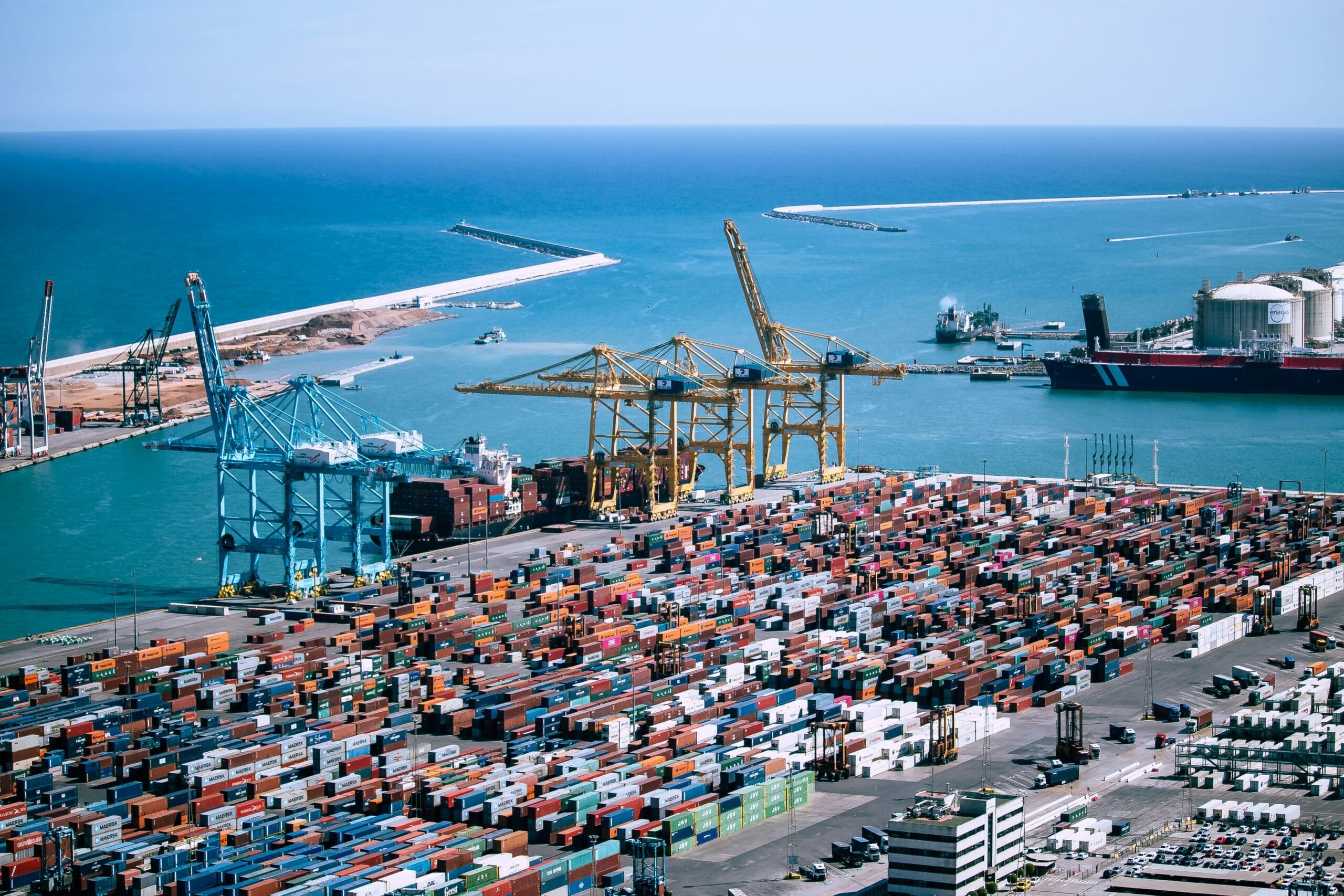
For decades India faced an awkward truth about its own coastline. The country sits astride some of the busiest sea lanes on the planet, yet not a single Indian port could berth the largest container ships afloat. Those mega vessels sailed past, dropping Indian cargo at Colombo, Singapore or Dubai for onward transfer. Vadhvan Port aims to end that dependency. Built off the coast of Maharashtra’s Palghar district, it will become India’s largest container port and one of its few genuine deep-water gateways, reshaping both the country’s trade economics and its maritime position in the Indian Ocean.
This deep-dive walks through what the Vadhvan Port project actually is, why its location matters, how it fits into India’s larger corridor strategy, and where the strategic and environmental stakes lie.
What is Vadhvan Port and Who is Building It
Vadhvan Port is an all-weather greenfield deep-draft major port being developed near Dahanu in Palghar district, Maharashtra, roughly 150 kilometres north of Mumbai. The Union Cabinet, chaired by Prime Minister Narendra Modi, approved the project on 19 June 2024 at a total cost of ₹76,220 crore including the land acquisition component. Prime Minister Modi laid the foundation stone on 30 August 2024.
The port belongs to a special purpose vehicle called Vadhvan Port Project Limited (VPPL). This entity was formed by the Jawaharlal Nehru Port Authority (JNPA) and the Maharashtra Maritime Board (MMB), holding 74 percent and 26 percent stakes respectively. The development follows a landlord port model, where the public authority builds the core infrastructure while private developers operate terminals and commercial facilities through public-private partnerships.
Once complete, Vadhvan will become India’s 13th major port. The scale is considerable. The Cabinet approval lays out nine container terminals, each 1,000 metres long, four multipurpose berths including a coastal berth, four liquid cargo berths, a Ro-Ro berth and a Coast Guard berth. The project involves reclaiming 1,448 hectares of area from the sea and constructing a 10.14 kilometre offshore breakwater to shield the harbour from monsoon waves.
The Scale: Capacity and Numbers in Context
The headline figure is capacity. Vadhvan will create a cumulative capacity of 298 million metric tonnes per annum, including around 23.2 million TEUs (twenty-foot equivalent units) of container handling capacity.
That number is hard to grasp in isolation, so it helps to anchor it against ports readers may know. JNPA, India’s largest public container port, handled a record 7.05 million TEUs in 2024, while Mundra, the private port in Gujarat that has edged ahead on box volume, handled 7.4 million TEUs in FY24. Colombo, the Sri Lankan hub that absorbs much of India’s transshipment, set its own record at 8.29 million TEUs in 2025. Vadhvan’s planned 23.2 million TEU capacity is therefore larger than India’s two busiest container ports combined. The yardstick at the very top of the table is Singapore, which crossed 40 million TEUs in 2024, so Vadhvan does not vault India into that league overnight. What it does is give India, for the first time, a single port built to a global mainline scale rather than a regional one.
In June 2026 the project moved from paper to construction in a visible way. Afcons Infrastructure received a letter of award from VPPL on 9 June 2026 to build the 10.14 kilometre offshore breakwater, the spine of the harbour that makes year-round berthing possible.
Why the Location Was Chosen: The Deep-Draft Problem
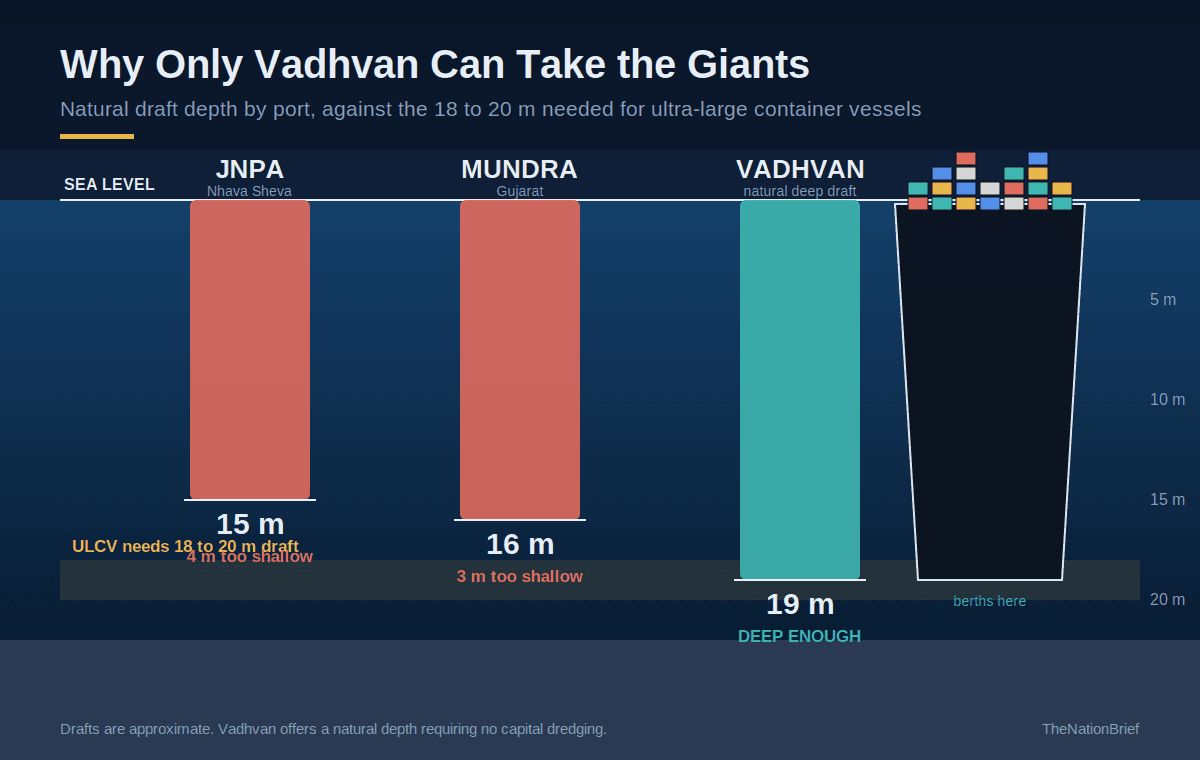
The case for Vadhvan rests on one number: 20 metres of natural water depth. According to JNPA, a natural depth of 20 metres is available about 10 kilometres from the shore, with a draft of 18 metres available without any capital dredging in the navigational channel and harbour area.
That matters because of how global shipping has evolved. The largest container vessels now carry between 16,000 and 25,000 TEUs, and they need a draft of 18 to 20 metres to berth safely. India’s two busiest container ports could not offer this. JNPA and Mundra operate at drafts of around 15 and 16 metres respectively, enough for mid-size ships but not the new generation of ultra-large container vessels.
Graphic: TheNationBrief.
The Transshipment Cost India Was Paying
As a result, the consequence was structural. Because no Indian port could handle the biggest ships directly, shipping lines simply bypassed India, and foreign hubs ended up handling Indian cargo. By one widely cited estimate, ports such as Colombo, Singapore, Port Klang, Salalah and Dubai transshipped around three million TEUs of Indian cargo each year, with Indian exporters paying an additional cost of roughly 80 to 100 US dollars per container for the privilege. Colombo alone handled the bulk of southern India’s transshipment traffic.
Vadhvan’s geography solves several problems at once. For one, the deep natural draft removes the need for expensive and recurring dredging. On top of that, the offshore approach means most of the port sits on reclaimed sea area rather than displacing large onshore settlements. Connectivity, too, is strong: the site is close to the Dedicated Rail Freight Corridor and the Mumbai-Vadodara Expressway, linking the port to industrial hinterlands across Maharashtra, Gujarat, western Madhya Pradesh and the wider north Indian belt.
There is also a relief valve dimension. JNPA faces both spatial and draft constraints as it approaches its planned ceiling. Vadhvan, therefore, aims to absorb the spillover, easing congestion across India’s western coast rather than simply competing with the existing port next door.
Vadhvan Compared to Its Peers and Rivals
The table below sets Vadhvan against the two Indian ports it will most affect and the foreign hub it is partly designed to bypass. The Vadhvan figures are planned capacity targets, while the others are recent throughput.
| Port | Country | Draft (approx) | Container capacity or throughput | Strategic role |
|---|---|---|---|---|
| Vadhvan | India | 18 to 20 m natural | 23.2 million TEUs (planned) | Deep-water mainline gateway, western anchor for IMEC and INSTC |
| JNPA (Nhava Sheva) | India | About 15 m | 7.05 million TEUs (2024) | India’s largest public container port, nearing capacity |
| Mundra | India | About 16 m | 7.4 million TEUs (FY24) | India’s busiest container port overall, strong rail links to the north |
| Colombo | Sri Lanka | Deep-water (CICT) | 8.29 million TEUs (2025) | Regional transshipment hub handling much of India’s transshipped cargo |
The pattern is clear. Vadhvan’s natural draft of 18 to 20 metres puts it in a different class from JNPA and Mundra, which cannot accommodate the largest vessels. Its planned capacity dwarfs both, and it directly targets the transshipment role that Colombo has played for Indian cargo.
Vadhvan and India’s Trade Corridor Strategy
Vadhvan is not a standalone project. It is a node in two of the corridor networks India has been building to reroute global trade through its own territory.
IMEC and INSTC: The Two Corridors
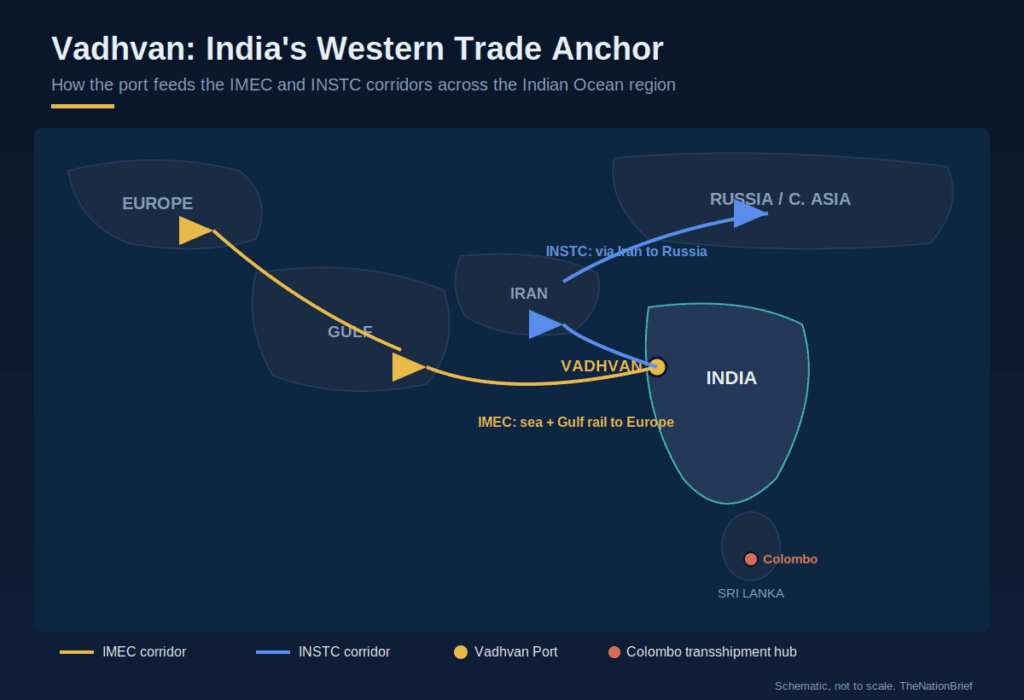
The first is the India-Middle East-Europe Economic Corridor (IMEC), the rail and shipping route that India unveiled during its G20 presidency to connect the country to the Gulf and onward to Europe. The second is the International North-South Transport Corridor (INSTC), the multimodal route linking India to Russia and Central Asia through Iran. The Cabinet approval explicitly states that Vadhvan’s capacity will aid EXIM trade flow through both IMEC and INSTC.
Map: TheNationBrief.
The logic is straightforward. A deep-water port on the Arabian Sea coast, capable of receiving the largest mainline vessels, becomes the natural western anchor for cargo moving between the Far East, Europe, the Middle East, Africa and the Americas. For exporters, a direct mainline call from Indian soil cuts out the transshipment leg, trimming both cost and transit time.
The Europe dimension is worth drawing out. Under the IMEC design, cargo would move by ship from India to ports in the Gulf, transfer onto rail networks running up through the Arabian peninsula, and then continue by sea to Europe. Vadhvan, as India’s deepest mainline gateway on the west coast, could emerge as the principal Indian maritime node feeding cargo into that Gulf rail leg. If the corridor matures, the combination of a deep-water Indian origin port and a rail shortcut across the Gulf holds the potential to trim transit times to Europe compared with the longer all-sea route through the Suez Canal. That potential remains contingent on the rail and political pieces of IMEC falling into place, which is a longer and less certain process than building the port itself.
From Logistics to Geoeconomics
This is where the project crosses from logistics into geoeconomics. India’s maritime sector carries 95 percent of the country’s trade by volume and 70 percent by value, yet India has historically punched below its weight in container handling. The dependence on Colombo was not only a financial cost but a security vulnerability, leaving a chunk of India’s trade flowing through a port where Chinese-operated terminals hold a sizeable position.
The Strategic and Maritime Dimension
For readers tracking India’s position in the Indian Ocean, Vadhvan reads as more than an economic project. It sits within a broader push to reduce reliance on foreign transshipment hubs and to claim a larger share of the value that India’s own trade generates.
The Western and Eastern Anchors
Pair Vadhvan with the planned transshipment hub at Galathea Bay in the Great Nicobar Islands and the design becomes clearer. Vadhvan anchors the western axis, feeding cargo towards the Gulf, Africa and Europe. Galathea Bay, meanwhile, serves the eastern Indian Ocean, consolidating cargo from India’s eastern coast and neighbouring states onto mainline routes. Together they target India’s core maritime weakness, namely the inability to directly handle ultra-large vessels and the resulting dependence on hubs such as Colombo and Singapore. Both sit within the wider shift in India’s maritime doctrine, which has moved over the past decade from guarding the Indian Ocean as a flank to actively shaping it.
The inclusion of a dedicated Coast Guard berth in the Vadhvan plan signals that the planners conceived the port with a security as well as a commercial function. Indeed, a major deep-water facility on the approaches to Mumbai adds to the maritime infrastructure available along a stretch of coast that carries enormous military and commercial weight. The connection to the China question is indirect but real: every tonne of Indian cargo that shifts from a foreign transshipment hub to an Indian deep-water port is a tonne that no longer depends on infrastructure outside India’s control.
The Colombo Factor and Chinese Terminals
To see why this matters, look at how Colombo operates. Colombo has long handled a large share of India’s transshipment, with the bulk of its transshipment business linked to the Indian market. Part of that traffic flows through the Colombo International Container Terminal (CICT), a deep-water facility operated with Chinese investment, alongside other terminals at the port. The result is an uncomfortable arrangement, where a meaningful slice of India’s external trade passes through a hub where a strategic rival holds an operating stake.
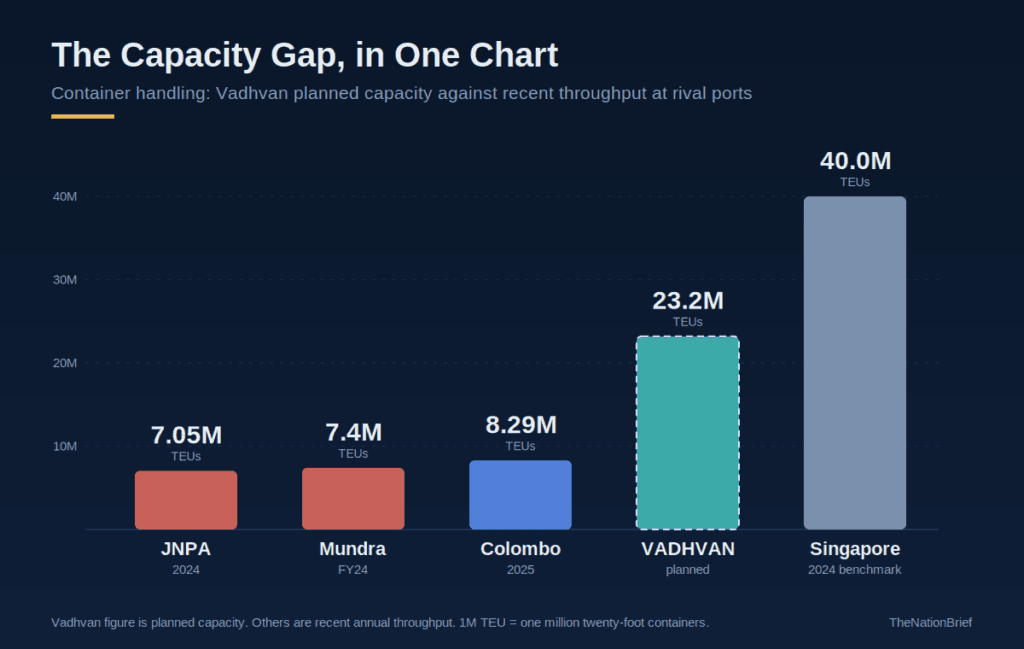
Chart: TheNationBrief.
This sits inside a wider contest. China has steadily built or financed port infrastructure across the Indian Ocean, from Hambantota in Sri Lanka to Gwadar in Pakistan, a pattern Indian strategists have watched closely for years. India’s response has been to expand its own maritime capacity rather than to match that footprint port for port. Vadhvan on the west coast, the Vizhinjam transshipment terminal in Kerala that began operations recently and the planned Galathea Bay hub in the Great Nicobar Islands together represent an effort to keep Indian cargo on Indian-controlled infrastructure and to reduce the leverage that foreign hubs hold over Indian trade. The same rivalry is playing out beneath the surface, where India is rebuilding the Indian Navy’s submarine fleet to counter a growing Chinese subsurface presence in these waters.
A Choice, Not a Necessity
The aim is not to sever ties with Colombo, which remains a useful partner and will keep handling Indian cargo as volumes grow. Rather, the aim is to ensure India has a credible domestic alternative, so that dependence becomes a choice rather than a necessity. In effect, a deep-water port at Vadhvan changes that calculation by giving the largest vessels a reason to call directly at an Indian terminal.
It is worth being precise here. Vadhvan is approved and under construction as a commercial major port, not a naval base. Instead, its strategic value flows from trade autonomy and from the maritime domain awareness that a Coast Guard presence brings, rather than from any stated military role. Ultimately, the official documents frame it as a trade gateway, and that framing should be respected when assessing its significance.
Jobs, Skilling and the Local Economy
The economic case extends inland. The government projects large employment gains, with the project expected to generate substantial direct and indirect jobs across construction, operations and the industrial activity that tends to cluster around a major port.
For residents of Palghar district, this is the kind of change that arrives once in a generation. A district that has sat on the northern edge of the Mumbai Metropolitan Region, more rural than industrial, stands to host what may be the largest single economic transformation the area has seen since the metropolitan region began pushing outward. The prospect carries both promise and pressure, jobs and infrastructure on one side, disruption to fishing livelihoods and land use on the other, which is why local sentiment around the project is mixed rather than uniformly enthusiastic.
VPPL has signed several agreements aimed at the local population of Palghar district. A memorandum of understanding between VPPL and the Directorate General of Shipping covers skill development training for locals and project-affected people through selected Maritime Training Institutes. The Vadhvan Port Skilling Programme, run with the Maharashtra government’s Skill Development Department, will set up training facilities in government ITI institutes across Palghar to make local youth employable at the port. A separate agreement with Sahyadri Farms targets rural entrepreneurship and the agri-value chain. VPPL has stressed that all official training under the skilling programme is free of cost, a caution against agencies falsely demanding fees.
Environmental and Social Concerns
A project of this scale carries real costs, and honest coverage has to name them. Reclaiming nearly 1,500 hectares of sea, constructing a 10 kilometre breakwater and dredging marine sand all carry ecological consequences for the Dahanu coast, an area with its own environmental protections and a fishing economy that long predates the port.
Local fishing communities and environmental groups have raised concerns about the impact on marine ecology and traditional livelihoods. The port authority states that the project incorporates sustainable development practices and ecological safeguards, and the project received environmental clearance and Coastal Regulation Zone approval before construction began. Whether those safeguards prove adequate in practice is a question that will follow the project through its build-out, and it deserves continued scrutiny rather than a single line of reassurance.
What Comes Next: The Vadhvan Timeline
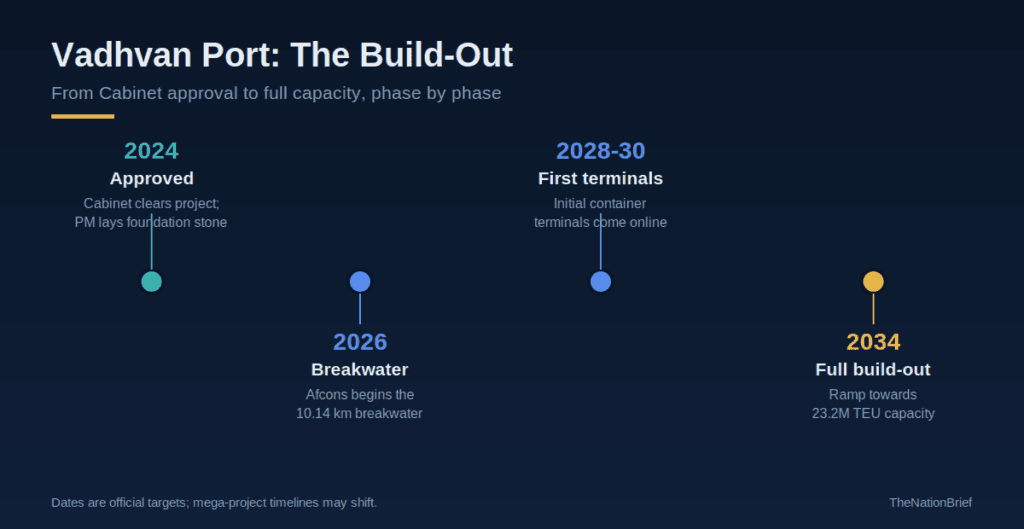
Timeline: TheNationBrief.
Vadhvan is a decade-long build, delivered in phases rather than a single switch-on. The broad sequence looks like this.
In 2026, construction moves into its first heavy phase. The Afcons contract for the 10.14 kilometre breakwater, awarded in June 2026, gets under way, alongside the dredging and reclamation work needed to create the artificial port platform from the sea.
Between roughly 2028 and 2030, the first container terminals are expected to come online as the reclaimed land and core infrastructure mature. This is the stage where Vadhvan begins handling cargo and starts to take pressure off JNPA.
From 2034 onwards, the project targets full build-out, with the port scheduled for completion around 2034 and capacity ramping towards the full 23.2 million TEU figure as the remaining terminals are commissioned. However, these dates are official targets, and as with any mega project, real-world execution may shift them.
Ultimately, if the project delivers on its design, India gains its first port capable of berthing the world’s largest container ships directly, a western anchor for the IMEC and INSTC corridors and a meaningful reduction in its dependence on foreign transshipment. If it stumbles on environmental, financing or execution risks, by contrast, it joins the long list of mega projects that promised more than they delivered. For now, with the Cabinet approval secured, the foundation stone laid and the first major construction contract awarded, Vadhvan Port stands as one of the most consequential infrastructure bets India has made on its own maritime future.
Sources
- Press Information Bureau, Cabinet approval for Vadhavan Port, PRID 2026695
- Press Information Bureau, foundation stone laying, PRID 2050143
- Press Information Bureau, New Major Ports, PRID 2040632
- Press Information Bureau, Vadhvan Port Project agreements, PRID 2148284
- Jawaharlal Nehru Port Authority, official Vadhvan Port page
- Vadhvan Port Project Limited, official website