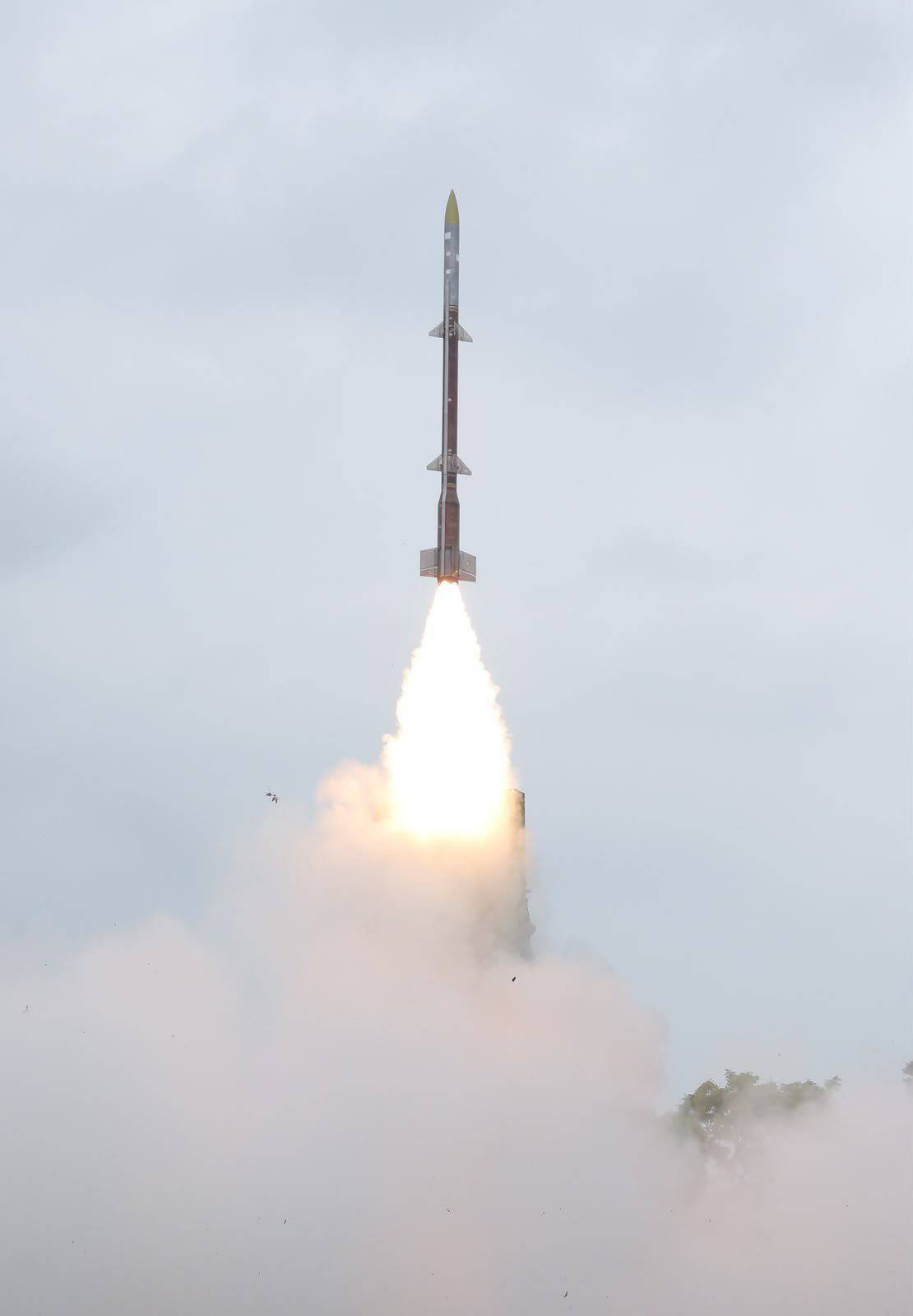
On Thursday morning, from APJ Abdul Kalam Island off the Odisha coast, DRDO fired a missile it has been promising for years. The Long-Range Surface-to-Air Missile Kusha flew its maiden test. Rajnath Singh called it a giant leap for Indian air defence and for once the ministerial adjective is not doing much heavy lifting. Fewer than half a dozen countries build long-range surface-to-air systems of this class and India has spent a decade trying to join them.
Project Kusha is not a single weapon but a family of three interceptors, stacked to cover different bands of sky. The M1, which flew on Thursday, reaches roughly 150 kilometres against fighters and precision weapons. It carries an AESA seeker and a dual-pulse rocket motor DRDO spent months validating on the ground. Above it sits the M2 at around 250 kilometres. The M3, still to fly, is meant to strike past 400.
Each tier plugs the holes in the one beside it, so an aircraft that beats the outer ring runs into the next. Kusha does not carry the whole load, though. It covers aircraft and cruise missiles, while India’s separate ballistic missile defence programme handles the steeper threats falling from the edge of space. Different physics, different interceptors.
What 400 Kilometres Really Buys
Range on a brochure means little. Range on a map changes how the other side flies.
A missile that reaches 400 kilometres does not need to hit anything to earn its cost. Enemy early warning aircraft cannot loiter where they used to, because loitering means dying. Mid-air refuellers, fat and slow and impossible to hide, lose their safe orbits. Fighters lean on those tankers for range and on those radar aircraft for the picture. Take both away and the same jets fly shorter sorties, later, knowing less.
Push the support aircraft back three hundred kilometres and the whole air battle moves with them, without anyone firing at a fighter. Air defence officers have understood this arithmetic for decades. It is why the S-400 rattled planners in Islamabad and Beijing long before it fired a shot in anger.
That is the company Kusha is trying to keep, though it is not a copy of the Russian system, whatever the shorthand comparisons suggest. DRDO built it around Indian requirements, Indian terrain and the threats the Air Force actually expects. That is a different design brief, even when the numbers look alike.
The Leash
The second argument is the one Rajnath Singh made himself and it is the older grievance in Indian defence.
India flies Russian S-400 squadrons bought at considerable expense, delivered on Moscow’s schedule and serviced at its convenience. Every spare, every patch, every upgrade travels through a supplier whose own war has stretched its industry thin. Anyone who watched deliveries slip after 2022 knows the cost. A system built at home cuts that leash. It also lets India wire the shield into its own radars and its own airborne surveillance fleet.
Kusha also anchors something larger. Mission Sudarshan Chakra aims to throw a layered shield over the country by 2035, knitting missiles, lasers and space sensors into one architecture. The Air Force has asked for around ten Kusha squadrons, which tells you where the system sits in that plan. Operation Sindoor, fought largely with drones, missiles and radars, made the case better than any brochure. The shield is not being built in isolation either. India’s deepening defence partnership with Israel is feeding the same architecture, with Iron Dome and Arrow under discussion as layers that could sit alongside Kusha rather than replace it.
The Long Middle
One test proves a missile can leave a launcher, find a target and destroy it. It proves nothing about a weapon system and the distance between the two is where Indian programmes usually lose their years.
Kusha must now fly again and again, against targets that manoeuvre and through jamming meant to blind it. The M2 and M3 have their own trial cycles ahead. Bharat Electronics has to deliver radars that hold a stealthy target at extreme range. Someone then has to write the software that makes ten squadrons behave as one shield rather than ten islands, passing targets without downing friendly aircraft. That last job is quieter than a missile launch and usually harder.
DRDO talks about deployment between 2028 and 2030. Treat it as an aspiration. Indian missile programmes have met such dates and missed them by years and this one carries more moving parts than most.
Still, something real happened off Odisha on Thursday. India fired the first interceptor of a shield it drew itself, into a neighbourhood filling up with drones, cruise missiles and stealth aircraft. The next air war over South Asia will turn partly on who can push the other side’s aircraft back. India has just started building the means to do it alone.
Image Credits:
Featured image: DRDO, via Ministry of Defence