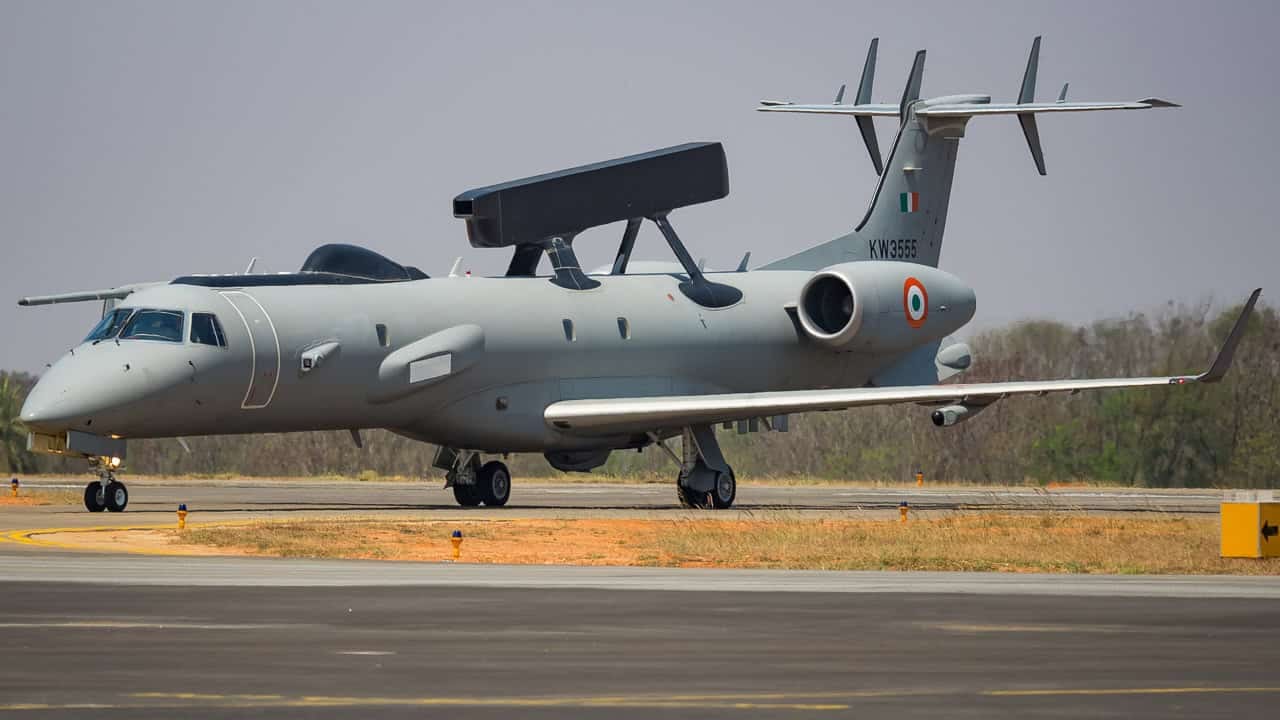
On 25 June 2026, at a ceremony in Bengaluru, DRDO handed the Indian Air Force a certificate that took nine years to earn. The document granted Final Operational Clearance to Netra. It is India’s home-grown airborne early warning and control system. In plain language, the paperwork declared what crews at a Punjab airbase have known for years. The aircraft that watched over the Balakot strikes and Operation Sindoor is now fully combat-ready. It is cleared for unrestricted frontline operations, with nothing left to prove.
The milestone closes one chapter and opens a larger one. India is about to spend 19,000 crore rupees building a bigger, sharper successor. To understand why that money matters, it helps to understand what Netra actually does and why a country with one of the world’s largest air forces still does not have enough of these aircraft.
What an Eye in the Sky Actually Does
Ground radars have a built-in blindness. The Earth curves and radar beams travel in straight lines. A fighter or cruise missile hugging the terrain can slip beneath the radar horizon. It stays invisible until it is dangerously close. The fix is simple in concept and brutal in engineering. Lift the radar into the sky, where the horizon stretches for hundreds of kilometres in every direction.
That is what an AEW&C aircraft is. A flying radar station and command post in one. Netra can detect, identify and classify aircraft, cruise missiles and drones. It sees far beyond the reach of ground stations. Its crew then does something more valuable than watching. Through secure data links, the system builds a live air picture. It shares that picture with fighters and ground commanders and directs interceptors onto threats. One aircraft turns a scattered collection of jets into a coordinated air battle. That battle is fought with better information than the other side has.
That difference showed in combat. During the Balakot operation in 2019 and again during Operation Sindoor, Netra provided the airborne surveillance and control that framed the fight. Combat use is the hardest test any system faces and Netra passed it years before its final certificate arrived. Few indigenous programmes anywhere can claim that sequence, where the battlefield validated the machine before the paperwork did.
What Exactly Was Cleared
The Netra Mk1 mounts a DRDO-developed active electronically scanned array radar on a modified Embraer EMB-145. Brazil supplies the twin-engine regional jet. Its radar sits in a distinctive beam-shaped dorsal unit along the top of the fuselage. It covers roughly 240 degrees, with a reported detection range of up to 375 kilometres. Around the radar sits a full mission suite. It includes friend-or-foe identification, electronic and communication support measures that sniff enemy radar and radio emissions, a mission computer and secure networks to move it all.
The Centre for Airborne Systems in Bengaluru, a DRDO lab, developed the system with the Air Force and Indian industry. Three aircraft exist. They fly with No. 200 Squadron from Bhisiana near Bathinda, watching India’s western front. One airframe, though, has spent much of its life supporting development work.
The clearance journey tells its own story about Indian defence programmes. Initial Operational Clearance came in 2017, allowing service use with caveats. Final Operational Clearance took until June 2026. That is the full certification that the system meets every Air Staff requirement. Nine years separated the two. That pace frustrates. But it also reflects a system refined through real operations, including actual combat, rather than rushed through a checklist.
The Uncomfortable Arithmetic
Here is the problem the celebration cannot hide. India operates three Israeli Phalcon AWACS mounted on Russian IL-76 aircraft. Add the three Netras. That makes six eyes in the sky, one of them often busy with trials. This for a country with two long, tense borders and thousands of kilometres of coastline. Air power planners consider that a fraction of what India’s geography demands. Continuous coverage of even one sector requires multiple aircraft rotating on station. Six airframes cannot watch two fronts at once.
The neighbours sharpen the point. Pakistan fields Saab 2000 Erieye aircraft and Chinese-built ZDK-03 systems. That gives it a surveillance fleet comparable in numbers to India’s, despite a far smaller air force. China operates multiple AWACS variants in serious quantity and keeps building more. In any coming crisis, the side that sees first shoots first and India’s margin here is thinner than its overall air strength suggests.
The mathematics of air surveillance is unforgiving. Each aircraft can stay on station for a limited number of hours before crew fatigue and fuel force a return. Sustaining one continuous orbit over a single sector can demand three or four airframes in rotation. Cover two fronts and a maritime approach and the numbers required climb far beyond anything six aircraft can deliver. This is the gap the next phase is built to close.
Update, July 2026: The threat runs both ways. India’s own Kusha long-range SAM, first flight tested on 23 July 2026, is designed to strike enemy early warning aircraft and tankers at up to 400 kilometres. Every air force building such a missile is also telling its own surveillance crews where they can no longer safely fly.
Netra Mk2: The 19,000 Crore Answer
On 17 July 2025, the Cabinet Committee on Security approved the Netra Mk2 programme at a cost of around 19,000 crore rupees. The plan converts six Airbus A321 airliners into a new generation of surveillance aircraft. The jets formerly flew with Air India and already serve an IAF communication squadron.
This new variant fixes the Mk1’s main limits. The A321 is a much larger aircraft than the Embraer. That means more fuel, longer endurance, more consoles and more crew. The radar arrangement changes too. Alongside the main dorsal antenna, the Mk2 adds an antenna in the nose. Coverage stretches to roughly 300 degrees. A more powerful mission suite aims to track more targets, of more types, at longer ranges. Adani Defence and Aerospace will serve as the lead integration partner. That places a private Indian firm at the centre of one of the country’s most sensitive aerospace projects. The first converted aircraft is expected in 2026-27, with the programme running about three years. Using second-hand airliners rather than new-build jets keeps costs down and speeds up the schedule, since the airframes already exist and their flying characteristics hold no surprises.
Beyond the Mk2 sits a still larger ambition: six full-size AWACS aircraft on the Airbus A330 platform. That project would give India the kind of heavy, long-endurance surveillance fleet that only a few air forces operate. Taken together, the roadmap runs from three small radars today toward a layered fleet of medium and heavy platforms watching both fronts.
Why Building It at Home Matters
India could have bought more foreign AWACS years ago and saved itself the wait. The reason it did not goes beyond pride.
An AEW&C system is not a product so much as a living piece of software and radar engineering that must be updated constantly as threats evolve. A country that owns the source code, the radar design and the integration know-how can upgrade on its own schedule. It can add its own weapons and data links and keep its secrets to itself. A country that imports stays dependent on a vendor for every change. The vendor sets the price and the pace. Surveillance aircraft also rank among the most export-restricted systems on Earth. That makes the supply insecure exactly when it matters most.
The Netra programme, for all its delays, bought India that ownership. That same logic runs through the country’s wider push to build difficult technology at home, from fighter jets to semiconductors. The pattern repeats because the lesson repeats. Hard capabilities bought abroad remain someone else’s to switch off.
There is an industrial dividend too. The Mk2 hands a complex integration job to Indian private industry, spreading skills beyond DRDO’s labs. Every console, antenna and line of code produced at home feeds an ecosystem that did not exist at the start. The programme began in 2004 with a modest budget and a small Bengaluru outfit.
The Road Ahead
The honest ledger has entries on both sides. Netra took over two decades from programme start to final clearance. No air force enjoys such a timeline. The fleet remains far too small. The Mk2 must still survive the journey from approved project to delivered aircraft, a path where Indian programmes have stumbled before. Aircraft conversions, radar integration and flight trials each carry their own delays. The 2026-27 target for the first Mk2 will demand discipline to hold.
Yet the direction is unmistakable. A system that began as a research gamble now flies combat missions and holds full operational clearance. It anchors a funded, approved expansion plan. The certificate handed over in Bengaluru was recognition, not a finish line. India’s eye in the sky has grown up. The task now is to multiply it. In the next air war over South Asia, the side that sees further will decide how it ends.
Image Credits:
Featured image: Venkat Mangudi, CC BY-SA 2.0, via Wikimedia Commons